---
marp: true
theme: kurzus
paginate: true
footer: Data Structures · Week 2 · Efficiency, searching
---
# Data Structures
## Week 2 – Efficiency of algorithms, linear and binary search
Dr. Ferenc Koczka · Eszterházy Károly University · 2026
---
## Review
- **Algorithm:** a finite, well-defined sequence of steps
- **Data type:** set of values + operations + representation
- **Data structure:** elements + relationships + operations
- Access: **direct** (array) · **sequential** (list)
### Questions for today
- How can we tell whether an algorithm is **fast** or **slow**?
- How do we find an element in an array – and can we do it **faster**?
---
# Efficiency of algorithms
---
## Why is a stopwatch not enough?
The running time depends on
- the machine (processor, memory),
- the programming language and the compiler,
- other running programs,
- **the size and content of the input**.
Therefore we do not measure in seconds; instead we examine how the **number of steps** grows as a function of the **input size (n)**.
**Step (elementary operation):** assignment, comparison, arithmetic operation, accessing an array element – each counts as one step.
---
## Counting steps: an example
Pseudocode – sum
```text
Function Sum(A, n)
s ← 0 // 1
For i ← 1 to n // n times
s ← s + A[i] // n
End for
Return s // 1
End function
```
- The assignment and the return: a **constant** number of steps
- The loop body runs **n** times
- In total about **c₁ · n + c₂** steps
The constants (c₁, c₂) depend on the machine – what matters is that the number of steps grows **linearly** with n.
---
## Best, worst and average case
Even for inputs of the same size the number of steps may differ!
**Example:** we search for the value `x` in an *n*-element array, from the front.
| Case | When? | Steps |
|---|---|---|
| **Best** | `x` is the first element | 1 |
| **Worst** | `x` is the last one, or not in the array | n |
| **Average** | `x` is equally likely anywhere | about n / 2 |
Usually we examine the **worst case**: it is a guarantee – it will certainly not be slower than that.
---
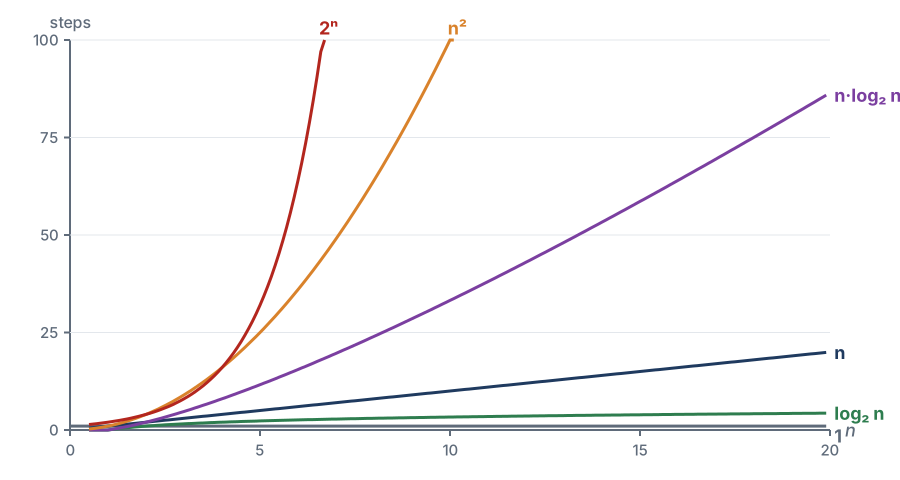
## Growth rates
---
## How long does this take in practice?
Assume the machine performs **10⁹ steps** per second.
| n | log₂ n | n | n · log₂ n | n² | 2ⁿ |
|---|---|---|---|---|---|
| 10 | 3 ns | 10 ns | 33 ns | 100 ns | 1 µs |
| 1 000 | 10 ns | 1 µs | 10 µs | 1 ms | ∞ (≈ 10²⁸⁴ years) |
| 10⁶ | 20 ns | 1 ms | 20 ms | **17 minutes** | ∞ |
| 10⁹ | 30 ns | 1 s | 30 s | **32 years** | ∞ |
A faster machine hardly helps: a **10× faster** machine turns 32 years into 3.2 years. A **better algorithm** is the solution.
---
## Big-O notation
**Intuitively:** `f(n) = O(g(n))` if *f* grows at most as fast as *g* (ignoring a constant factor).
**Precisely:** `f(n) = O(g(n))` if there are constants *c* > 0 and *n₀* such that
> f(n) ≤ c · g(n) for every n ≥ n₀.
**Rules:**
- Constant factors can be dropped: `5n = O(n)`
- Only the highest-order term counts: `3n² + 10n + 7 = O(n²)`
- The base of the logarithm does not matter: `log₂ n = O(log n)`
Related notations: Ω (lower bound), Θ (exact order).
---
## Common orders of growth
| Notation | Name | Example |
|---|---|---|
| O(1) | constant | accessing an array element by index, stack `push` |
| O(log n) | logarithmic | binary search |
| O(n) | linear | linear search, sum, maximum |
| O(n log n) | “n log n” | merge sort, quicksort (on average) |
| O(n²) | quadratic | bubble sort, examining every pair |
| O(2ⁿ) | exponential | examining every subset |
Rule of thumb: for n = 10⁶ elements, O(n log n) is perfectly fine, O(n²) is not.
---
## Determining the order from code
```java
// O(n)
for (int i = 0; i < n; i++)
sum += a[i];
// O(n²)
for (int i = 0; i < n; i++)
for (int j = 0; j < n; j++)
count++;
```
```java
// O(log n) – halving
while (n > 1)
n = n / 2;
// O(n) + O(n²) = O(n²)
for (int i = 0; i < n; i++) ...
for (int i = 0; i < n; i++)
for (int j = i; j < n; j++) ...
```
- **In sequence:** the costs add up → the larger one counts
- **Nested:** the costs multiply
- **Halving:** if every step halves the problem → log n
---
## Space complexity
Not only time but **memory** is a resource too.
- **Space complexity:** the memory needed in addition to the input, as a function of n
- Linear and binary search: **O(1)** – only a few helper variables
- Making a copy of an array: **O(n)**
We often have to choose **between time and space**: with more memory (e.g. a hash table, week 11) searching can be faster.
---
# Searching in an array
---
## Linear (sequential) search

- Going from the front, we compare every element with the value we are looking for
- The array does **not** need to be sorted
- Also works on a linked list (sequential access)
---
## Linear search – algorithm
Pseudocode
```text
Function LinearSearch(A, n, x)
i ← 1
While i ≤ n and A[i] ≠ x
i ← i + 1
End while
If i ≤ n then
Return i
else
Return 0 // not found
End if
End function
```
**Steps:** **O(n)** in the worst case
Java
```java
static int linearSearch(int[] a, int x) {
int i = 0;
while (i < a.length && a[i] != x)
i++;
return i < a.length ? i : -1;
}
```
Go
```go
func linearSearch(a []int, x int) int {
for i, v := range a {
if v == x {
return i
}
}
return -1
}
```
---
## Attention: the order of the conditions!
```text
While i ≤ n and A[i] ≠ x
```
- If `i = n + 1`, then `A[i]` is a **non-existent** element
- Thanks to **short-circuit evaluation** this is still correct: if `i ≤ n` is false, `A[i] ≠ x` is not evaluated
In the reverse order (`A[i] ≠ x and i ≤ n`) we get an `ArrayIndexOutOfBoundsException` in Java and an `index out of range` error in Go.
---
## Sentinel search
**Idea:** put the value we are looking for at the end of the array (position *n* + 1) – then we will certainly find it, and the index bound need not be checked.
Pseudocode
```text
Function SentinelSearch(A, n, x)
A[n + 1] ← x // sentinel
i ← 1
While A[i] ≠ x
i ← i + 1
End while
If i ≤ n then Return i
else Return 0
End function
```
- **One** comparison per step instead of two
- Still **O(n)**, but about half as many comparisons
- Needs one **extra slot** at the end of the array
| Variant | x = 4 not present, n = 7 |
|---|---|
| simple | 15 comparisons |
| sentinel | 8 comparisons |
We will use the sentinel idea again for the sentinel list in week 10.
---
## Searching a sorted array – linearly
If the array is **sorted**, we can stop as soon as we reach an element **greater** than `x`.
```text
Function SortedLinear(A, n, x)
i ← 1
While i ≤ n and A[i] < x
i ← i + 1
End while
If i ≤ n and A[i] = x then Return i
else Return 0
End function
```
- An unsuccessful search is faster on average
- But the worst case is still **O(n)** – can we do better?
---
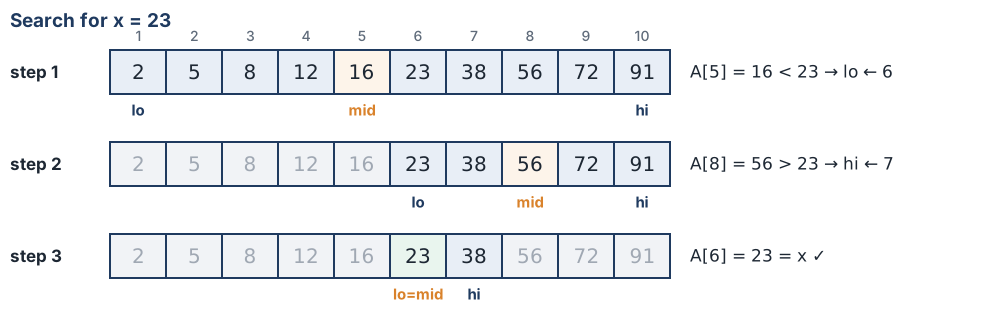
## Binary search – the idea
**Precondition:** the array is **sorted**.
1. Look at the **middle** element
2. If it is the one we want: done
3. If the value we want is **smaller**: continue in the left half
4. If the value we want is **larger**: continue in the right half
In every step the search range is **halved**.
Like looking up a word in a dictionary (or a name in a phone book): we do not turn every page, we open it in the middle and decide which way to go.
---
## Binary search – example
---
## Binary search – algorithm
Pseudocode
```text
Function BinarySearch(A, n, x)
lo ← 1
hi ← n
While lo ≤ hi
k ← (lo + hi) div 2
If A[k] = x then
Return k
else if A[k] < x then
lo ← k + 1
else
hi ← k − 1
End if
End while
Return 0
End function
```
Java
```java
static int binarySearch(int[] a, int x) {
int lo = 0, hi = a.length - 1;
while (lo <= hi) {
int mid = lo + (hi - lo) / 2;
if (a[mid] == x) return mid;
if (a[mid] < x) lo = mid + 1;
else hi = mid - 1;
}
return -1;
}
```
Go
```go
for lo <= hi {
mid := lo + (hi-lo)/2
switch {
case a[mid] == x: return mid
case a[mid] < x: lo = mid + 1
default: hi = mid - 1
}
}
```
---
## Binary search – efficiency
After every step the size of the range is at most half: n → n/2 → n/4 → … → 1
At most **⌊log₂ n⌋ + 1** steps → **O(log n)**
| n | linear (worst case) | binary (worst case) |
|---|---|---|
| 10 | 10 | 4 |
| 1 000 | 1 000 | 10 |
| 1 000 000 | 1 000 000 | 20 |
| 1 000 000 000 | 1 000 000 000 | 30 |
Finding a name in a sorted list of the whole population of China (1.4 billion): **at most 31 steps**.
---
## Binary search – typical mistakes
- The array is **not sorted** → wrong result (but no error message!)
- `lo < hi` instead of `lo ≤ hi` → the one-element range is skipped
- `lo ← k` instead of `lo ← k + 1` → possible **infinite loop**
- `(lo + hi) / 2` → **overflow** for large indexes
instead: `lo + (hi − lo) / 2`
This bug was present for years in the `Arrays.binarySearch` function of the Java library (fixed in 2006).
**Built-in versions:** Java `Arrays.binarySearch(a, x)` · Go `sort.SearchInts(a, x)`
---
## Linear or binary?
| | Linear | Binary |
|---|---|---|
| Precondition | none | **sorted** array |
| Access | sequential is enough | **direct** access needed |
| Steps | O(n) | O(log n) |
| On a linked list | ✓ | ✗ (no direct access) |
If we search the same data many times, it pays to **sort once** (O(n log n), week 13); after that every search is O(log n).
---
## Summary
- Efficiency is measured by the **growth of the number of steps** as a function of the input size
- Usually we examine the **worst case**
- **Big-O:** constants and lower-order terms can be dropped
- Orders: O(1) < O(log n) < O(n) < O(n log n) < O(n²) < O(2ⁿ)
- **Linear search:** O(n), on any array · with a sentinel, fewer comparisons
- **Binary search:** O(log n), only on a **sorted** array with direct access
**Next week:** arrays – one- and multidimensional arrays, storage, address calculation, dynamic arrays.
---
## Review questions
1. What is the order (in big-O) of `3n² + 100n + 5`? And of `n + log n`?
2. True or false: binary search is O(n).
3. True or false: binary search also works in O(log n) steps on a linked list.
4. At most how many steps does binary search need to find an element in a 500-element array?
5. What happens if we run binary search on an unsorted array?
6. What is the order of the following code?
`for (i = 1; i < n; i = i * 2) for (j = 0; j < n; j++) …`
---
# Practice
---
## Demo programs
| Program | Java | Go | What does it show? |
|---|---|---|---|
| Linear search | `LinearSearch.java` | `w02/linearsearch` | simple, sentinel and sorted variants; number of comparisons |
| Binary search | `BinarySearch.java` | `w02/binarysearch` | printing the steps, table of worst cases |
| Timing | `Timing.java` | `w02/timing` | O(n) vs. O(log n) vs. O(n²) in reality |
Run the `Timing` program and observe: when n grows tenfold, how do the times of linear and binary search change? When n doubles, how does the time of the O(n²) algorithm change?
---
## Exercises
1. **Maximum:** return the index of the largest element of the array! How many steps does it take?
2. **Counting:** how many elements of the array are equal to `x`?
3. **First occurrence:** in a sorted array where a value may occur **several times**, find the **first** occurrence of `x` in O(log n) steps! (`[1,2,2,2,5] , x=2 → 1`)
4. **Insertion position:** return the index where `x` can be inserted so that the array stays sorted!
5. **Integer square root:** using binary search, find the largest *r* with *r*² ≤ *n*!
6. **Guess the number:** the computer thinks of a number between 1 and 1000, we get “smaller/larger” answers. At most how many questions are needed?
Solutions: `Exercises02.java`, `w02/exercises`
---
## Homework
1. Give the order (in big-O)!
a) `for i ← 1 to n: for j ← 1 to 10: …`
b) `for i ← 1 to n: for j ← 1 to i: …`
c) `i ← n; While i > 0: i ← i div 3`
2. Run binary search on paper on the array `[3, 8, 15, 21, 30, 42, 57, 66, 81]` for `x = 57` and `x = 10`! Write down the values of `lo`, `hi` and `k` in every step!
3. Write a function that counts how many times `x` occurs in a **sorted** array, in O(log n) steps!