---
marp: true
theme: kurzus
paginate: true
footer: Data Structures · Week 3 · Arrays
---
# Data Structures
## Week 3 – Arrays: one- and multidimensional arrays, storage, dynamic arrays
Dr. Ferenc Koczka · Eszterházy Károly University · 2026
---
## Review
- **Big-O notation:** the order of the number of steps – O(1), O(log n), O(n), O(n²)
- **Linear search:** O(n), on any array
- **Binary search:** O(log n), on a sorted array, **direct access** needed
### Questions for today
- How does the machine store an array, and why is access O(1)?
- How much does inserting or deleting an element cost?
- How can a static array be “extended”?
---
## The concept of an array
An **array** is a finite sequence of elements of the same type, accessed by an **index**.
| Property | Array |
|---|---|
| Element type | **homogeneous** |
| Size | **static** – fixed at creation |
| Storage | **contiguous** – the elements follow each other directly |
| Access | **direct** – any element in O(1) time |
| Relationship | **linear** |
Also called: **vector** (one-dimensional), **matrix** (two-dimensional)
---
## Arrays in Java and Go
Java
```java
int[] a = new int[5]; // filled with 0
int[] p = {2, 3, 5, 7, 11};
p[0] = 1;
int n = p.length; // 5
for (int x : p)
System.out.print(x + " ");
int[] b = a; // the SAME array
int[] c = Arrays.copyOf(p, p.length);
```
- The array is an **object**, the variable is a reference
- Default values: `0`, `0.0`, `false`, `null`
Go
```go
var a [5]int // filled with 0
p := [5]int{2, 3, 5, 7, 11}
p[0] = 1
n := len(p) // 5
for _, x := range p {
fmt.Print(x, " ")
}
b := a // a COPY!
s := []int{2, 3, 5} // slice
```
- The size is **part of the type**: `[5]int` ≠ `[6]int`
- An array is a **value** – in practice we use slices (`[]int`)
---
## Storage in memory

The address of the *i*-th element is obtained by **a single calculation**:
> addr(A[i]) = base address + i · element size (indexing from 0)
> addr(A[i]) = base address + (i − 1) · element size (indexing from 1)
That is why access is **O(1)** – there is no need to walk through the previous elements.
---
## Why does indexing start at 0?
- With 0-based indexing the index is the element's **offset** from the start of the array
- `A[0]` is at the base address, `A[3]` is three elements further
- C, Java, Go, Python: from 0 · Pascal, Fortran, Lua, mathematics: from 1
In pseudocode we index **from 1**, in programs **from 0**. When translating:
`For i ← 1 to n` → `for (int i = 0; i < n; i++)`
### Bounds checking
- Java: `ArrayIndexOutOfBoundsException` · Go: `panic: index out of range`
- C has no check: the program silently **overwrites** neighbouring memory – a source of serious security bugs
---
## Cost of the operations
| Operation | Steps | Why? |
|---|---|---|
| reading / writing the *i*-th element | **O(1)** | address calculation |
| search (unsorted) | O(n) | linear search |
| search (sorted) | O(log n) | binary search |
| insertion at the end (if there is room) | O(1) | |
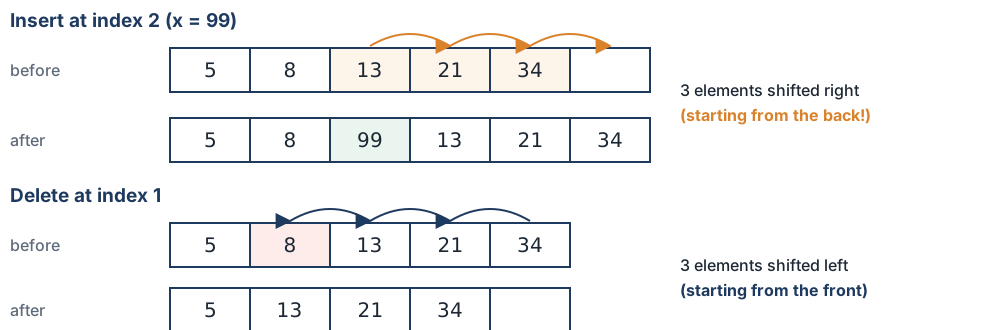
| insertion at the beginning / in the middle | **O(n)** | elements must be shifted |
| deletion at the beginning / in the middle | **O(n)** | elements must be shifted |
An array is **fast for reading** and **slow for modification** – if we insert and delete a lot in the middle, a **linked list** (week 9) may be a better choice.
---
## Insertion and deletion
---
## Insertion and deletion – algorithm
Insertion at position k
```text
Procedure Insert(A, n, k, x)
// precondition: n < capacity
For i ← n down to k
A[i + 1] ← A[i]
End for
A[k] ← x
n ← n + 1
End procedure
```
Deletion at position k
```text
Procedure Delete(A, n, k)
For i ← k to n − 1
A[i] ← A[i + 1]
End for
n ← n − 1
End procedure
```
Java
```java
static int insert(int[] a, int n,
int pos, int x) {
for (int i = n - 1; i >= pos; i--)
a[i + 1] = a[i];
a[pos] = x;
return n + 1;
}
```
When inserting, shifting must start **from the back**! Going from the front, every element would be overwritten by the first shifted value.
---
## Reversing and rotating in place
**Reversing** with two indexes – O(n), O(1) space
```text
Procedure Reverse(A, n)
i ← 1 ; j ← n
While i < j
swap(A[i], A[j])
i ← i + 1 ; j ← j − 1
End while
End procedure
```
`[1 2 3 4 5]` → `[5 4 3 2 1]`
**Rotating left by k positions** – with three reversals
`[1 2 | 3 4 5]`, k = 2
1. reverse the first k elements: `[2 1 | 3 4 5]`
2. reverse the rest: `[2 1 | 5 4 3]`
3. reverse the whole array: `[3 4 5 1 2]` ✓
Without a helper array, in O(n) steps.
---
# Multidimensional arrays
---
## Two-dimensional array (matrix)
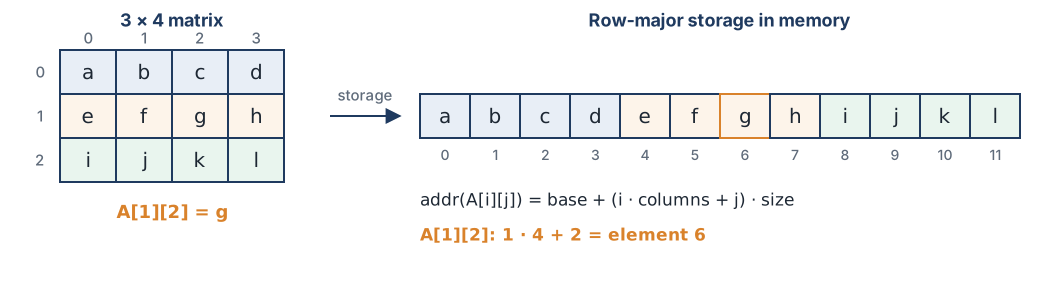
- Memory is **one-dimensional** – the matrix must be “flattened” into a sequence
- **Row-major** storage (C, Java, Go): first the first row, then the second …
- **Column-major** storage (Fortran, MATLAB): first the first column …
---
## Address calculation: the general formula
An *N* × *M* matrix (N rows, M columns), element size *s*, base address *k*:
| | indexing from 0 | indexing from 1 |
|---|---|---|
| Row-major | k + (i · M + j) · s | k + ((i − 1) · M + (j − 1)) · s |
| Column-major | k + (j · N + i) · s | k + ((j − 1) · N + (i − 1)) · s |
**Example:** `int A[10][20]` (4-byte elements), base address 2000, row-major, indexing from 0.
addr(A[3][5]) = 2000 + (3 · 20 + 5) · 4 = 2000 + 260 = **2260**
Three-dimensional array `A[i][j][l]`, dimensions N × M × L: k + ((i · M + j) · L + l) · s
---
## 2D arrays in Java: an array of arrays
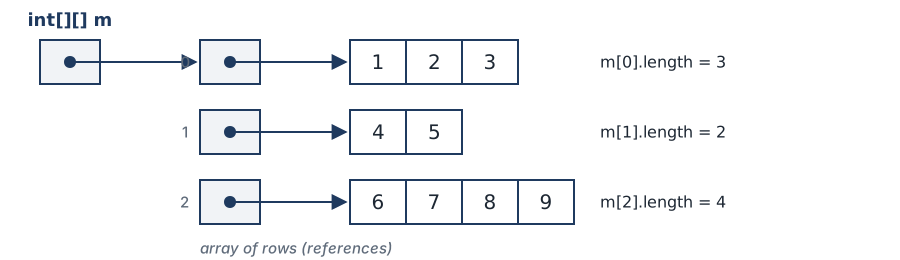
```java
int[][] m = new int[3][4]; // 3 rows, each of length 4
int[][] jagged = { {1, 2, 3}, {4, 5}, {6, 7, 8, 9} };
```
- Every row is a **separate object** → the rows may have different lengths (*jagged array*)
- `m.length` is the number of rows, `m[i].length` is the length of the *i*-th row
---
## 2D arrays in Go
**True 2D array** – one contiguous block
```go
var grid [3][4]int
grid[1][2] = 7
```
- The size is known at compile time
- Exactly row-major storage
**Slice of slices** – like in Java
```go
m := make([][]int, rows)
for i := range m {
m[i] = make([]int, cols)
}
```
- The size can be given at run time
- The rows may have different lengths
When traversing a matrix, the **row-major** order (outer loop over the rows) is faster, because it makes better use of the processor cache.
---
## Matrix operations
**Main and anti-diagonal** – O(n)
```text
For i ← 1 to n
main ← main + A[i, i]
anti ← anti + A[i, n − i + 1]
End for
```
**Transposition** – O(n · m)
```text
For i ← 1 to n
For j ← 1 to m
T[j, i] ← A[i, j]
End for
End for
```
**Matrix multiplication** – (n×k) · (k×m), **O(n · k · m)**
```text
For i ← 1 to n
For j ← 1 to m
C[i, j] ← 0
For x ← 1 to k
C[i, j] ← C[i, j] + A[i, x] · B[x, j]
End for
End for
End for
```
For square matrices **O(n³)** – three nested loops.
---
# Dynamic arrays
---
## The problem: the size of an array is fixed
- We often **do not know in advance** how many elements must be stored (e.g. data read from input)
- Too small array → it does not fit · too large array → waste
**Solution: dynamic array** – an array that is **replaced by a larger one** when necessary
- `size` (length): how many elements it actually contains
- `capacity`: the size of the backing array
Java: `ArrayList` · Go: slice + `append` · C++: `vector` · Python: `list`
---
## How a dynamic array works
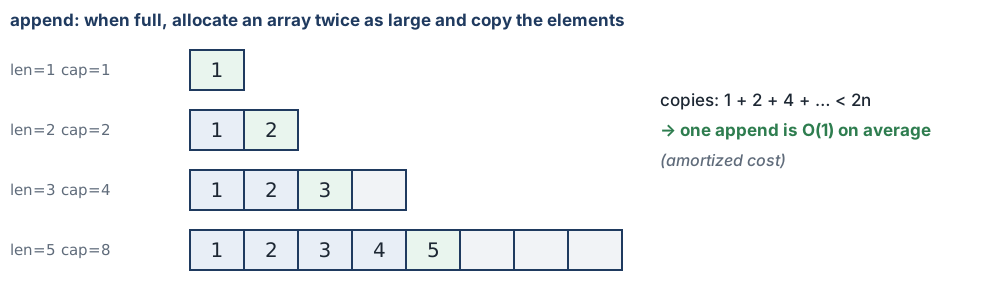
- Growing by one each time: 1 + 2 + 3 + … + n = **O(n²)** copies in total
- **By doubling:** 1 + 2 + 4 + … + n < 2n → O(n) in total, **O(1)** per element
---
## Our own dynamic array
Java
```java
class DynamicArray {
private int[] data = new int[1];
private int size = 0;
void add(int x) {
if (size == data.length) {
int[] bigger =
new int[2 * data.length];
for (int i = 0; i < size; i++)
bigger[i] = data[i];
data = bigger;
}
data[size++] = x;
}
int get(int i) { return data[i]; }
}
```
Go
```go
type DynamicArray struct {
data []int
size int
}
func (d *DynamicArray) Add(x int) {
if d.size == len(d.data) {
bigger := make([]int, 2*len(d.data))
copy(bigger, d.data[:d.size])
d.data = bigger
}
d.data[d.size] = x
d.size++
}
```
Measurement: 1 000 000 `add` calls → **1 048 575** copies, **1.05** per element
---
## Go slice: length, capacity, backing array
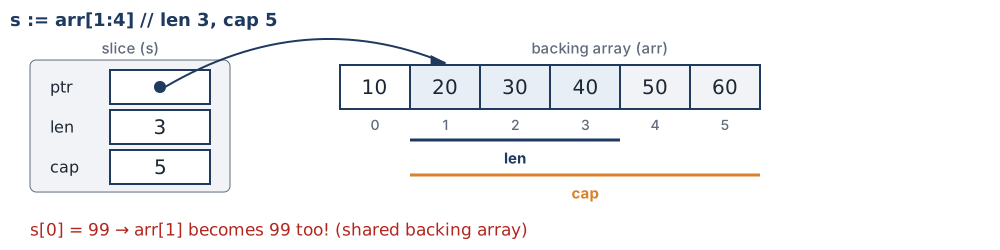
- A slice consists of three values: a **pointer** to the backing array, the **length** (`len`) and the **capacity** (`cap`)
- `append` allocates a new array only when the capacity runs out
- That is why we always write: `s = append(s, x)` – the result must be assigned back!
---
## Java `ArrayList`
```java
ArrayList list = new ArrayList<>();
list.add(5); // at the end – amortized O(1)
list.add(0, 3); // insertion at the beginning – O(n)
list.get(1); // reading – O(1)
list.set(1, 9); // writing – O(1)
list.remove(0); // deletion by index – O(n)
list.size(); // number of elements
```
- Stores **objects** only: `Integer` instead of `int` (automatic boxing and unboxing)
- Internally an `Object[]` array, grown by a factor of 1.5 when full
---
## Summary
- The array is a **homogeneous, static, contiguous, direct-access** data structure
- Address calculation: `base address + index · element size` → access **O(1)**
- Insertion and deletion in the middle are **O(n)** – elements must be shifted
- Matrix: **row-major** storage, address = k + (i · M + j) · s
- Java: a 2D array is an array of arrays · Go: `[N][M]T` or `[][]T`
- **Dynamic array:** doubling the capacity → appending is amortized **O(1)**
**Next week:** strings – sequences of characters, encoding, operations, pattern matching.
---
## Review questions
1. True or false: the elements of an array are scattered in memory.
2. How many steps does it take to delete the first element of an *n*-element array?
3. An `int A[5][8]` matrix is stored row-major from address 100, with 4-byte elements, indexing from 0. What is the address of `A[2][3]`?
4. Why must shifting start from the back when inserting?
5. Why do we double the capacity of a dynamic array instead of increasing it by one?
6. What does it print? `s := []int{1,2,3}; t := s; t[0] = 9; fmt.Println(s[0])`
---
# Practice
---
## Demo programs
| Program | Java | Go | What does it show? |
|---|---|---|---|
| Basics | `ArrayBasics.java` | `w03/arraybasics` | creation, default values, bounds, copying |
| Operations | `ArrayOps.java` | `w03/arrayops` | insertion, deletion, reversal, rotation |
| Matrix | `Matrix.java` | `w03/matrix` | diagonals, transposition, multiplication, jagged array |
| Dynamic array | `DynamicArray.java` | `w03/dynarray` | doubling the capacity, number of copies, `append` |
In the `dynarray` Go program, observe how the capacity of the built-in `append` grows, and what happens with a shared backing array!
---
## Exercises
1. **Average:** compute the average of the elements of an integer array!
2. **Contains:** decide whether the array contains a given value!
3. **Second largest:** find the second largest (distinct) element with a **single** pass!
4. **Removing duplicates:** remove the duplicates from a **sorted** array in place, and return the new length! (`[1,1,2,3,3,3,5] → [1,2,3,5]`)
5. **Merging:** merge two sorted arrays into one sorted array in O(n + m) steps!
6. **Row and column sums:** compute the sum of every row and column of a matrix!
7. **Spiral:** print the elements of a matrix in spiral order! (`1 2 3 6 9 8 7 4 5`)
Solutions: `Exercises03.java`, `w03/exercises`
---
## Homework
1. Extend our own `DynamicArray` class with `insert(i, x)` and `remove(i)` operations! How many steps do they take?
2. Write `remove` so that the capacity is halved when the array becomes **a quarter** full! Why not halve it when it is half full?
3. Write a program that rotates an *n* × *n* matrix **in place** by 90 degrees clockwise! (Hint: transposition + reversing the rows.)
4. Compute: `double T[50][40]` (8-byte elements) column-major, indexing from 1, base address 5000. What is the address of `T[12][7]`?