---
marp: true
theme: kurzus
paginate: true
footer: Data Structures · Week 4 · Strings
---
# Data Structures
## Week 4 – Strings: representation, encoding, operations, pattern matching
Dr. Ferenc Koczka · Eszterházy Károly University · 2026
---
## Review
- An array is **homogeneous, static, contiguous, with direct access**
- Address calculation → access **O(1)** · insertion/deletion in the middle **O(n)**
- **Dynamic array:** doubling the capacity → appending is amortized O(1)
### Questions for today
- How does the machine store text – and how can `len("世界") == 6`?
- Why is `+` concatenation in a loop slow?
- How do we find a word in a text?
---
## The concept of a string
A **string** (character string, text) is a finite sequence of characters.
- Essentially a **character array** – plus text-specific operations
- **Length:** the number of characters · **empty string:** `""` (length 0)
- **Substring:** a contiguous section of characters (`"data"` is part of `"database"`)
| Property | String |
|---|---|
| Elements | homogeneous (characters) |
| Storage | contiguous |
| Access | direct (by index) |
| Mutability | Java, Go: **immutable** |
---
## Ways of representation
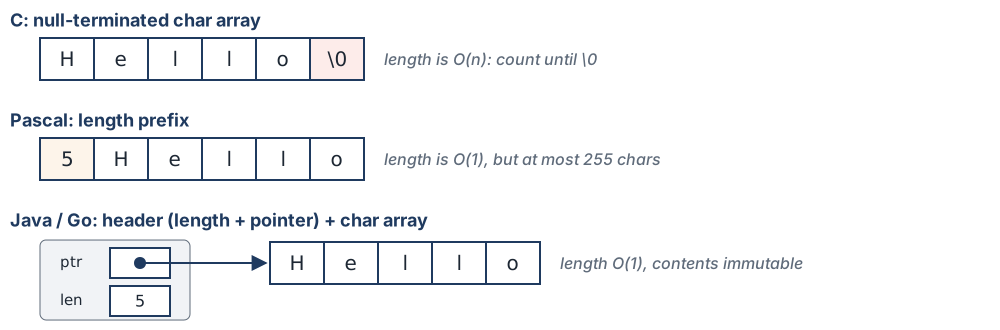
---
# Character encoding
---
## ASCII, Unicode, UTF-8
- **ASCII** (1963): 7 bits, 128 characters – English alphabet, digits, punctuation
- **Unicode:** every character of every writing system gets a number, the **code point**
`A` = U+0041 · `é` = U+00E9 · `世` = U+4E16 · `😀` = U+1F600
- The code point must be converted into bytes: **encoding**
| Encoding | Size of one character | Used by |
|---|---|---|
| **UTF-8** | 1–4 bytes (ASCII = 1 byte) | the web, Linux, **Go** |
| **UTF-16** | 2 or 4 bytes | **Java**, Windows, JavaScript |
| UTF-32 | always 4 bytes | rarely |
| GB 2312 / GBK / GB 18030 | 1–4 bytes | Chinese standards |
---
## UTF-8: variable-length encoding
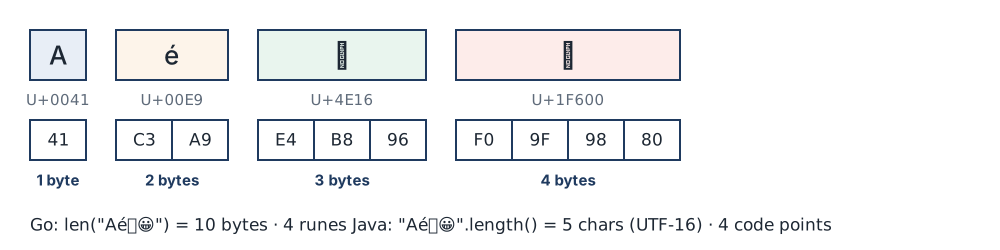
The answer to “how many characters?” depends on what we count: **bytes**, **UTF-16 units** or **code points**.
---
## Characters in Java and Go
Java – UTF-16
```java
String s = "Aé世😀";
s.length(); // 5 (char)
s.codePointCount(0, s.length()); // 4
s.charAt(2); // '世'
s.getBytes(UTF_8).length; // 10
// iterating by code point:
s.codePoints().forEach(cp -> ...);
```
- `char` = 16 bits → an emoji takes **two** `char`s (surrogate pair)
- Most Chinese characters take **one** `char`
Go – UTF-8
```go
s := "Aé世😀"
len(s) // 10 (bytes!)
utf8.RuneCountInString(s) // 4
s[2] // 0xA9 – a single byte!
[]rune(s)[2] // '世'
for i, r := range s { // rune by rune
fmt.Printf("%d %c\n", i, r)
}
```
- `s[i]` gives a **byte**, `range` gives a **rune**
- For character-by-character work: `[]rune(s)`
---
## Character arithmetic
The codes of the English letters and of the digits are **consecutive**:
| | Code | Consequence |
|---|---|---|
| `'0'` … `'9'` | 48 … 57 | value of a digit: `c - '0'` |
| `'A'` … `'Z'` | 65 … 90 | position of a letter: `c - 'A'` |
| `'a'` … `'z'` | 97 … 122 | lower case → upper case: `c - 32` |
```java
int digit = '7' - '0'; // 7
char upper = (char) ('g' - ('a' - 'A')); // 'G'
int[] freq = new int[26];
freq[c - 'a']++; // letter frequency
```
A 26-element array is a simple way to count letter frequencies, but it only works for the English alphabet. In general we use a **hash table** (week 11).
---
# String operations
---
## Immutable strings
In Java and Go the content of a string **cannot change after creation**.
```java
String s = "hello";
s.toUpperCase(); // returns a new string, s does not change!
s = s.toUpperCase(); // this is the way
```
**Advantages:**
- Can be shared safely (between variables, between threads)
- Can be used as a key in a hash table
- Java: the **string pool** stores identical literals only once
**Disadvantage:** every “modification” creates a new string → **copying**
---
## Concatenation in a loop: O(n²)!
```java
// SLOW – O(n²)
String s = "";
for (int i = 0; i < n; i++)
s += "x"; // new string + copying
```
```java
// FAST – O(n)
StringBuilder sb = new StringBuilder();
for (int i = 0; i < n; i++)
sb.append("x");
String s = sb.toString();
```
Go: `strings.Builder` · `sb.WriteString("x")`
| n | `+=` | Builder |
|---|---|---|
| 10 000 | 10 ms | 0.05 ms |
| 40 000 | 46 ms | 0.08 ms |
| 160 000 | 624 ms | 0.4 ms |
(Go, measured values)
Internally, `StringBuilder` is a **dynamic array** (week 3) – amortized O(1) append.
---
## Comparison
**Lexicographic (dictionary) order:** character by character from the left, the first difference decides; if one is a prefix of the other, the shorter one is smaller.
```text
Function Compare(S, T) // −1, 0 or 1
i ← 1
While i ≤ length(S) and i ≤ length(T) and S[i] = T[i]
i ← i + 1
End while
If i ≤ length(S) and i ≤ length(T) then
If S[i] < T[i] then Return −1 else Return 1
else if length(S) = length(T) then Return 0
else if length(S) < length(T) then Return −1
else Return 1
End function
```
`"apple" < "apply"` · `"data" < "database"` · `"Zebra" < "apple"` (an upper-case letter has a smaller code!)
---
## A common mistake in Java: `==` vs `equals`
```java
String a = "data";
String b = "data"; // the same object (string pool)
String c = new String("data"); // a new object
a == b // true – by accident!
a == c // false – a different object
a.equals(c) // true – the contents are equal
```
In Java, strings are **always compared with `equals`**. `==` compares the **references** (week 1).
In Go, `==` compares the **contents**: `a == c` → `true`
---
## Operations: Java and Go
| Operation | Java | Go | Steps |
|---|---|---|---|
| length | `s.length()` | `len(s)` (bytes) | O(1) |
| i-th character | `s.charAt(i)` | `s[i]` (byte) | O(1) |
| substring | `s.substring(a, b)` | `s[a:b]` | O(b−a) / O(1)* |
| concatenation | `s + t`, `s.concat(t)` | `s + t` | O(n + m) |
| equality | `s.equals(t)` | `s == t` | O(n) |
| comparison | `s.compareTo(t)` | `s < t`, `strings.Compare` | O(n) |
| search | `s.indexOf(t)` | `strings.Index(s, t)` | O(n · m)** |
| splitting | `s.split(",")` | `strings.Split(s, ",")` | O(n) |
| replacement | `s.replace(a, b)` | `strings.ReplaceAll(s, a, b)` | O(n) |
| lower / upper case | `toLowerCase()`, `toUpperCase()` | `strings.ToLower`, `ToUpper` | O(n) |
* In Go a substring does not copy, it refers to the shared bytes. ** Libraries also use smarter algorithms.
---
## A classic task: palindrome
**Palindrome:** reads the same backwards – `"radar"`, `"上海自来水来自海上"`
Pseudocode
```text
Function Palindrome(S, n)
i ← 1 ; j ← n
While i < j and S[i] = S[j]
i ← i + 1
j ← j − 1
End while
Return i ≥ j
End function
```
Two indexes move towards each other – **O(n)**, O(1) space.
Go – Unicode-safe
```go
func isPalindrome(s string) bool {
r := []rune(s)
for i, j := 0, len(r)-1; i < j;
i, j = i+1, j-1 {
if r[i] != r[j] {
return false
}
}
return true
}
```
Checked byte by byte in Go, the Chinese text would **not** be a palindrome!
---
# Pattern matching
---
## The pattern matching problem
**Given:** a **text** (S) of length *n* and a **pattern** (P) of length *m*, m ≤ n.
**Task:** where does P first occur in S?
Applications: the “find” function of text editors, `grep`, virus scanners, analysing **DNA sequences**, plagiarism detection
**Naive (brute-force) algorithm:**
- Try every possible starting position of the pattern: i = 1, 2, …, n − m + 1
- At each position compare the pattern with the text character by character
- At the first mismatch move on to the next position
---
## Naive pattern matching – example
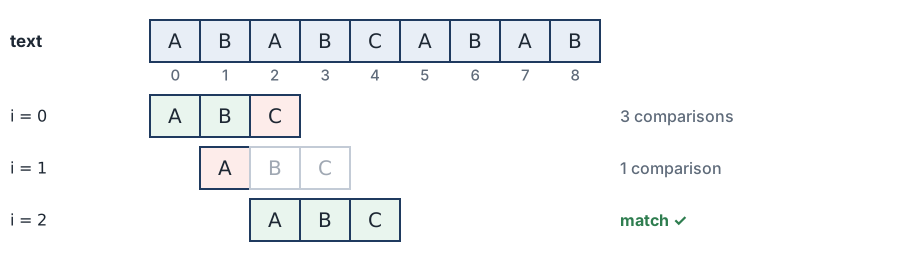
**7** character comparisons in total
---
## Naive pattern matching – algorithm
Pseudocode
```text
Function NaiveSearch(S, n, P, m)
For i ← 1 to n − m + 1
j ← 1
While j ≤ m and S[i + j − 1] = P[j]
j ← j + 1
End while
If j > m then Return i
End for
Return 0
End function
```
Java
```java
static int naiveSearch(String s, String p) {
int n = s.length(), m = p.length();
for (int i = 0; i <= n - m; i++) {
int j = 0;
while (j < m &&
s.charAt(i + j) == p.charAt(j))
j++;
if (j == m) return i;
}
return -1;
}
```
---
## Efficiency of the naive algorithm
- **Best case:** the pattern is at the beginning → O(m)
- **Worst case:** at every position it almost matches to the end
S = `aaaa…aab` (n = 10 001), P = `aa…ab` (m = 101)
→ **1 000 001** comparisons ≈ n · m → **O(n · m)**
- In natural text a mismatch is usually found within the first 1–2 characters → fast in practice
### More efficient algorithms (mentioned only)
- **Knuth–Morris–Pratt (KMP):** O(n + m) – learns from the structure of the pattern, never steps back in the text
- **Boyer–Moore:** compares from right to left, makes big jumps – very fast in practice
- **Rabin–Karp:** compares hash values (week 11)
---
## Summary
- A string is a **sequence of characters**, stored contiguously, with direct access
- Encoding: **Unicode** code point → **UTF-8** (Go, web) or **UTF-16** (Java)
- “Length” can mean bytes, UTF-16 units or code points – in Go `len(s)` gives bytes!
- Java and Go strings are **immutable** → in loops use `StringBuilder` / `strings.Builder`
- In Java use `equals`, not `==`!
- **Naive pattern matching:** O(n · m) in the worst case; better: KMP, Boyer–Moore
**Next week:** sorting I – bubble sort, selection sort and insertion sort.
---
## Review questions
1. What is the value of `len("中国")` in Go, and of `"中国".length()` in Java?
2. True or false: in Java, after calling `s.toUpperCase()`, `s` is in upper case.
3. Why is the following code O(n²)? `for (...) s += "x";`
4. Which is lexicographically smaller: `"data"` or `"Data"`? Why?
5. How many character comparisons does the naive algorithm make for `S = "AAAAA"` and `P = "AAB"`?
6. What does Java print: `new String("go") == "go"`?
---
# Practice
---
## Demo programs
| Program | Java | Go | What does it show? |
|---|---|---|---|
| Basics | `StringBasics.java` | `w04/stringbasics` | operations, `==` vs `equals`, comparison |
| Encoding | `Encoding.java` | `w04/encoding` | bytes, `char`, code points, UTF-8 bytes |
| Builder | `Builder.java` | `w04/builder` | `+=` vs `StringBuilder` timing |
| Pattern matching | `PatternSearch.java` | `w04/patternsearch` | naive search, all occurrences, worst case |
---
## Exercises
1. **Palindrome:** decide whether a sentence is a palindrome (ignoring case and punctuation)! (`"A man, a plan, a canal: Panama"` ✓)
2. **Word count:** how many words are in a text, if the words are separated by one or more spaces?
3. **Letter frequency:** count the occurrences of the English letters with a 26-element array!
4. **Caesar cipher:** shift the letters by *k* positions (`"Hello" → "Khoor"`, k = 3), and decode it!
5. **Anagram:** do two words consist of the same letters? (`listen` – `silent`)
6. **Compression:** `"aaabbcdddd" → "a3b2c1d4"`
7. **Reversing words:** `"I love data structures" → "structures data love I"`
Solutions: `Exercises04.java`, `w04/exercises`
---
## Homework
1. Write lexicographic comparison **without library functions** (returning `-1`, `0`, `1`)!
2. Write a function that returns the starting index of **every** occurrence of a pattern – including overlapping ones! (in `"aaaa"`, `"aa"`: 0, 1, 2)
3. Write a program that prints the **most frequent** word of a text! (Hint: Java `HashMap`, Go `map[string]int`.)
4. In Go: write a function that reverses a string so that Chinese characters and emojis are displayed correctly too!