---
marp: true
theme: kurzus
paginate: true
footer: Data Structures · Week 5 · Sorting I
---
# Data Structures
## Week 5 – Sorting I: bubble sort, selection sort and insertion sort
Dr. Ferenc Koczka · Eszterházy Károly University · 2026
---
## Review
- **Binary search:** O(log n) – but only on a **sorted** array!
- Moving elements in an array is costly: insertion, deletion **O(n)**
- Comparing strings: **lexicographic** order
### Questions for today
- How can we put an array in order?
- How many comparisons and moves does it take?
- When should we choose which simple sort?
---
## The sorting problem
**Given:** a sequence of *n* elements that can be compared (≤ relation).
**Task:** rearrange the elements so that A[1] ≤ A[2] ≤ … ≤ A[n].
### Why is it important?
- **Fast search:** binary search on a sorted array – O(log n)
- **Grouping:** equal elements end up next to each other (duplicates, frequencies)
- **Presentation:** alphabetical lists, rankings, chronological order
- By some estimates, a considerable part of all computing time is spent on sorting
---
## Concepts
- **Comparison:** examining the relation of two elements (`A[i] < A[j]`) – the main cost of sorting
- **Move / swap:** relocating elements – one swap is 3 assignments
- **In-place sorting:** needs only O(1) extra memory
- **Stable sorting:** elements with equal keys **keep** their original order
- **Comparison sort:** decides the order of the elements by comparisons only
Today we learn three **simple** sorting algorithms with O(n²) steps. The faster O(n log n) methods come in week 13.
---
# Bubble sort
---
## Bubble sort – the idea
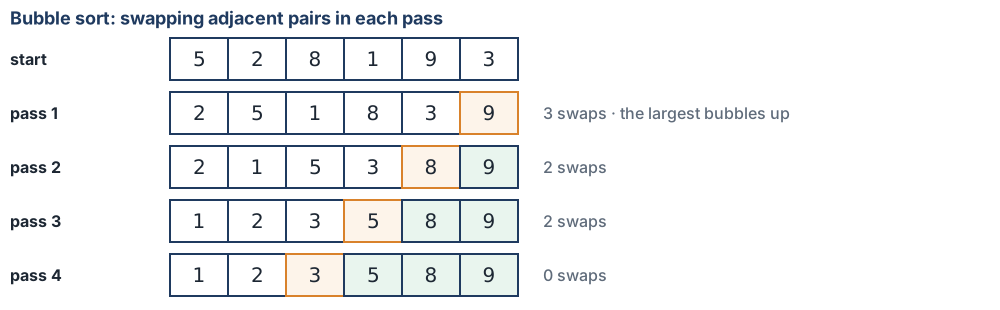
- Walk through the array and compare **neighbouring** elements
- If they are in the wrong order, **swap** them
- After one pass the **largest** element is at the end of the array (it “bubbles up”)
- Repeat on the unsorted part
---
## Bubble sort – algorithm
Pseudocode
```text
Procedure BubbleSort(A, n)
For i ← n down to 2
swapped ← false
For j ← 1 to i − 1
If A[j] > A[j + 1] then
swap(A[j], A[j + 1])
swapped ← true
End if
End for
If not swapped then
exit the loop
End for
End procedure
```
Java
```java
for (int i = n - 1; i >= 1; i--) {
boolean swapped = false;
for (int j = 0; j < i; j++)
if (a[j] > a[j + 1]) {
int t = a[j];
a[j] = a[j + 1];
a[j + 1] = t;
swapped = true;
}
if (!swapped) break;
}
```
Go
```go
if a[j] > a[j+1] {
a[j], a[j+1] = a[j+1], a[j]
swapped = true
}
```
---
## Bubble sort – analysis
| Case | Comparisons | Swaps |
|---|---|---|
| Best (already sorted) | n − 1 | 0 |
| Worst (reversed) | n(n − 1) / 2 | n(n − 1) / 2 |
| Average | ~ n² / 2 | ~ n² / 4 |
- Steps: **O(n²)** · on a sorted array, with the `swapped` flag: **O(n)**
- Sorts **in place**, **stable** (never swaps equal elements)
- The number of swaps = the number of **inversions** (pairs in the wrong order)
In practice it is the slowest of the simple sorts – it makes a lot of swaps.
---
# Selection sort
---
## Selection sort – the idea
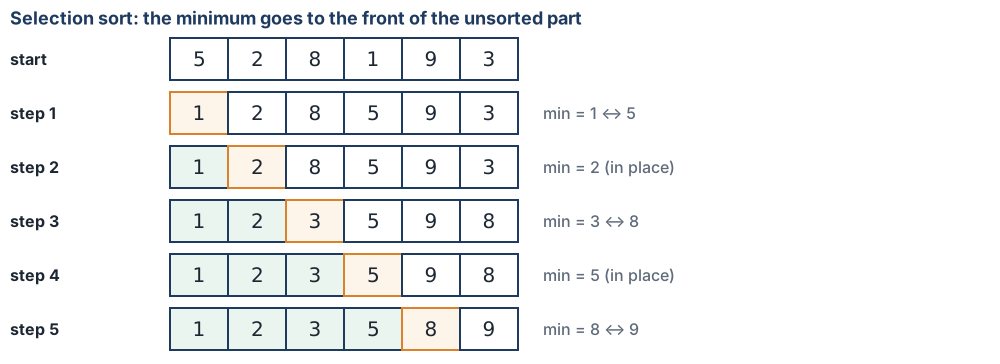
- Find the **smallest** element and swap it into the **first** position
- In the remaining (unsorted) part find the smallest and put it into the **second** position
- … and so on
---
## Selection sort – algorithm
Pseudocode
```text
Procedure SelectionSort(A, n)
For i ← 1 to n − 1
min ← i
For j ← i + 1 to n
If A[j] < A[min] then
min ← j
End if
End for
swap(A[i], A[min])
End for
End procedure
```
The inner loop is a **minimum selection** (week 2: maximum selection).
Java
```java
for (int i = 0; i < n - 1; i++) {
int min = i;
for (int j = i + 1; j < n; j++)
if (a[j] < a[min]) min = j;
int t = a[i];
a[i] = a[min];
a[min] = t;
}
```
Go
```go
for i := 0; i < len(a)-1; i++ {
min := i
for j := i + 1; j < len(a); j++ {
if a[j] < a[min] {
min = j
}
}
a[i], a[min] = a[min], a[i]
}
```
---
## Selection sort – analysis
| Case | Comparisons | Swaps |
|---|---|---|
| Every case | n(n − 1) / 2 | n − 1 |
- Steps: **always O(n²)** – it scans the rest even on a sorted array
- Only **n − 1 swaps** – useful when moving is very expensive (large records)
- Sorts **in place**
- **Not stable:** a long-distance swap may jump over an equal element
`[5a, 5b, 2]` → `[2, 5b, 5a]`
---
# Insertion sort
---
## Insertion sort – the idea
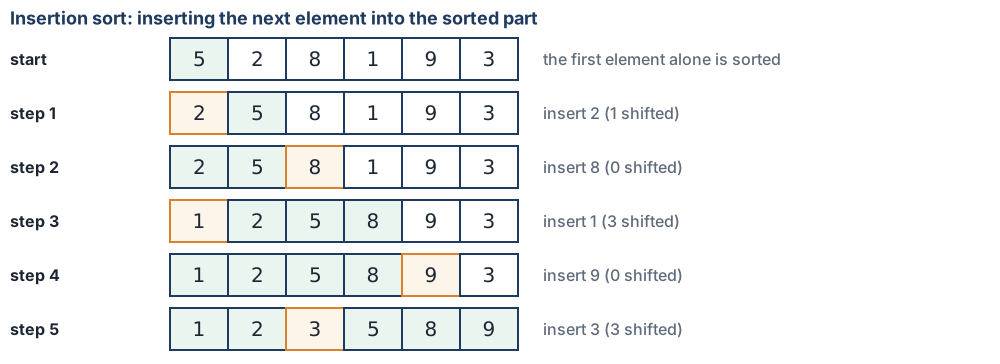
- We sort the way we sort playing cards in our hand: the next card is **inserted** into its place among the already sorted cards
- The beginning of the array is sorted; the next element is shifted left until it reaches its place
---
## Insertion sort – algorithm
Pseudocode
```text
Procedure InsertionSort(A, n)
For i ← 2 to n
x ← A[i]
j ← i − 1
While j ≥ 1 and A[j] > x
A[j + 1] ← A[j]
j ← j − 1
End while
A[j + 1] ← x
End for
End procedure
```
It does not swap but **shifts**: one step is one assignment.
Java
```java
for (int i = 1; i < n; i++) {
int x = a[i];
int j = i - 1;
while (j >= 0 && a[j] > x) {
a[j + 1] = a[j];
j--;
}
a[j + 1] = x;
}
```
Go
```go
for i := 1; i < len(a); i++ {
x, j := a[i], i-1
for j >= 0 && a[j] > x {
a[j+1] = a[j]
j--
}
a[j+1] = x
}
```
---
## Insertion sort – analysis
| Case | Comparisons | Moves |
|---|---|---|
| Best (already sorted) | n − 1 | 2(n − 1) |
| Worst (reversed) | n(n − 1) / 2 | ~ n² / 2 |
| Average | ~ n² / 4 | ~ n² / 4 |
- Steps: **O(n²)**, on a sorted or **nearly sorted** array **O(n)**
- Sorts **in place**, **stable** (`A[j] > x`, not `≥`!)
- **Online:** it can sort the elements in the order they arrive
- The fastest on small arrays (n < 20) – professional sorts (Java, Go libraries) use it for small parts
---
# Comparison
---
## Measurements (n = 1000)
Number of comparisons / moves (`SortCompare` program):
| | random | sorted | reversed |
|---|---|---|---|
| **bubble** | 499 004 / 750 423 | **999 / 0** | 499 500 / 1 498 500 |
| **selection** | 499 500 / **2 997** | 499 500 / 2 997 | 499 500 / 2 997 |
| **insertion** | **251 585** / 252 589 | **999 / 1 998** | 499 500 / 501 498 |
Move = assignment (one swap is 3 assignments). Note: selection sort always takes **the same** number of steps, insertion sort is **linear** on sorted data.
---
## Stability
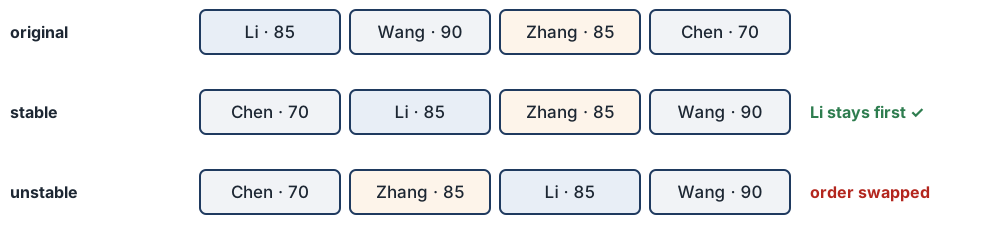
- **Why does it matter?** If we sort first by name and then by score with a **stable** sort, students with equal scores stay in alphabetical order
- Stable: bubble, insertion · Not stable: selection
---
## Which one should we choose?
| | Bubble | Selection | Insertion |
|---|---|---|---|
| Worst case | O(n²) | O(n²) | O(n²) |
| Best case | O(n) | O(n²) | O(n) |
| Swaps / moves | many | **few (n − 1)** | medium |
| Stable | yes | no | yes |
| In place | yes | yes | yes |
- In general: **insertion sort** – simple, fast on nearly sorted data
- When moving is expensive: **selection sort**
- Bubble sort: mainly for teaching purposes
None of them is good for large *n*: for n = 10⁶, ~10¹² steps. Solution: **merge sort** and **quicksort** (week 13), O(n log n).
---
## Built-in sorting
Java
```java
int[] a = {5, 2, 8, 1};
Arrays.sort(a); // primitives: Dual-Pivot Quicksort
String[] s = {"Wuhan", "Eger"};
Arrays.sort(s); // objects: TimSort (stable)
list.sort(Comparator
.comparing(Student::score));
```
Go
```go
a := []int{5, 2, 8, 1}
slices.Sort(a) // pdqsort
sort.Strings(s)
slices.SortStableFunc(st,
func(x, y Student) int {
return x.Score - y.Score
})
```
In practice we use the library sort – but **we must know how it works** and how fast it is in which case.
---
## Summary
- **Bubble:** swapping neighbours, the largest goes to the end in each pass · O(n²), stable
- **Selection:** the minimum goes to the front · always O(n²), only n − 1 swaps, not stable
- **Insertion:** the next element is inserted into the sorted part · O(n²), O(n) on sorted data, stable
- All three sort **in place**
- **Stability:** the original order of elements with equal keys is preserved
**Next week:** the set data structure – boolean vector, unsorted and sorted representation, set operations.
---
## Review questions
1. Sort the array `[4, 1, 3, 2]` on paper with all three methods! Write down the states step by step!
2. True or false: selection sort finishes in O(n) steps on a sorted array.
3. Which sort makes the fewest swaps? How many?
4. True or false: bubble sort is stable.
5. How many comparisons does insertion sort make on a reversed 10-element array?
6. What happens if insertion sort uses `A[j] ≥ x` instead of `A[j] > x`?
---
# Practice
---
## Demo programs
| Program | Java | Go | What does it show? |
|---|---|---|---|
| Simple sorts | `SimpleSorts.java` | `w05/simplesorts` | all three sorts, printed step by step |
| Comparison | `SortCompare.java` | `w05/sortcompare` | comparisons, moves, time on different inputs |
Run the `SortCompare` program! Which sort depends on the input, and which does not? When *n* doubles, how does the running time change?
---
## Exercises
1. **Is it sorted?** Decide in O(n) steps whether an array is sorted in increasing order!
2. **Descending order:** rewrite insertion sort for descending order!
3. **Strings:** sort an array of city names with selection sort!
4. **Records:** sort students (name, score) by score **stably**!
5. **k smallest:** find the *k* smallest elements of an array with the first *k* steps of selection sort! How many steps does it take?
6. **Counting sort:** sort exam grades (1–5) without comparisons, using a 6-element counting array! How many steps does it take?
7. **Inversions:** count the pairs in the wrong order in an array! How is this related to bubble sort?
Solutions: `Exercises05.java`, `w05/exercises`
---
## Homework
1. **Cocktail sort:** a variant of bubble sort that goes alternately left to right and right to left. Implement it, and measure how many comparisons it saves on the array `[2, 3, 4, 5, 1]`!
2. **Binary insertion sort:** find the insertion position with binary search (week 2)! How do the numbers of comparisons and moves change?
3. Give an example proving that selection sort is **not stable**!
4. Sort the students **primarily by score** in descending order, **by name for equal scores**! (Hint: two stable sorts one after the other, or a composite comparison.)