---
marp: true
theme: kurzus
paginate: true
footer: Data Structures · Week 6 · Set
---
# Data Structures
## Week 6 – The set data structure: representations and operations
Dr. Ferenc Koczka · Eszterházy Károly University · 2026
---
## Review
- **Array:** direct access O(1), insertion/deletion O(n)
- **Binary search** in a sorted array: O(log n)
- **Sorting:** bubble, selection, insertion – O(n²)
- **Merging** (week 3, exercise 5): two sorted arrays into one sorted array, O(n + m)
### Questions for today
- How can a mathematical set be represented in a computer?
- How fast are the set operations in each representation?
---
## Mathematical background
**Set:** an **unordered** collection of distinct elements.
- Every element occurs **at most once**: {1, 2, 2} = {1, 2}
- The order **does not matter**: {1, 2} = {2, 1}
- Notation: x ∈ A (element of) · |A| (number of elements) · ∅ (empty set) · **U** (universe)
| Operation | Notation | Meaning |
|---|---|---|
| Membership | x ∈ A | is x in A |
| Subset | A ⊆ B | every element of A is also an element of B |
| Union | A ∪ B | elements of A **or** B |
| Intersection | A ∩ B | common elements of A **and** B |
| Difference | A \ B | elements of A that are **not** in B |
---
## Set operations illustrated
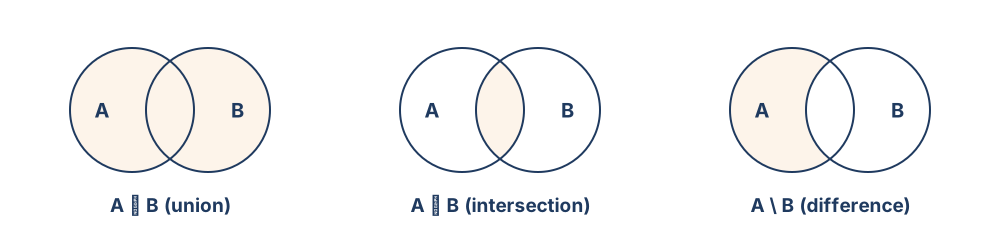
**Example** – U = the days of the week:
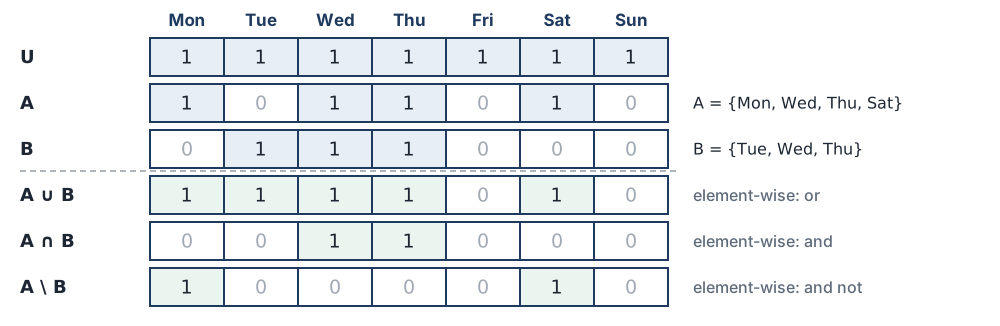
A = {Mon, Wed, Thu, Sat} (training days) · B = {Tue, Wed, Thu} (class days)
A ∪ B = {Mon, Tue, Wed, Thu, Sat} · A ∩ B = {Wed, Thu} · A \ B = {Mon, Sat}
---
## The set as a data structure
| Property | Set |
|---|---|
| Elements | homogeneous |
| Relationship between elements | **none** (no order) |
| Size | dynamic (can grow and shrink) |
| Duplicates | none |
**Possible representations** (all based on arrays):
1. **Boolean vector** (characteristic vector, bit vector)
2. **Unsorted** array (sequence)
3. **Sorted** array (sequence)
4. Hash table (week 11), search tree (week 15)
---
# Representation by a boolean vector
---
## Boolean vector
If the **universe is small and known** (U = {u₁, …, uₙ}), every set is a boolean vector of length *n*: **A[i] = true ⇔ uᵢ ∈ A**
---
## Boolean vector – operations
Pseudocode
```text
Function Member(A, i) // O(1)
Return A[i]
End function
Procedure Union(A, B, C, n) // O(n)
For i ← 1 to n
C[i] ← A[i] or B[i]
End for
End procedure
// Intersection: C[i] ← A[i] and B[i]
// Difference: C[i] ← A[i] and not B[i]
Function Subset(A, B, n) // A ⊆ B ?
i ← 1
While i ≤ n and (not A[i] or B[i])
i ← i + 1
End while
Return i > n
End function
```
Java
```java
boolean[] in = new boolean[7];
BitVectorSet union(BitVectorSet o) {
BitVectorSet r = new BitVectorSet();
for (int i = 0; i < in.length; i++)
r.in[i] = in[i] || o.in[i];
return r;
}
```
| Operation | Steps |
|---|---|
| membership, insertion, deletion | **O(1)** |
| union, intersection, difference | O(\|U\|) |
| subset | O(\|U\|) |
| number of elements | O(\|U\|) |
---
## Bit mask: one bit = one element
If |U| ≤ 64, the whole set fits into **a single integer**: the *i*-th bit shows whether uᵢ ∈ A.
| Operation | Java | Go | Example (A = 0101101, B = 0001110) |
|---|---|---|---|
| union | `a \| b` | `a \| b` | 0101111 |
| intersection | `a & b` | `a & b` | 0001100 |
| difference | `a & ~b` | `a &^ b` | 0100001 |
| membership (i) | `(a >> i & 1) == 1` | `a>>i&1 == 1` | |
| subset | `(a & ~b) == 0` | `a&^b == 0` | |
| number of elements | `Integer.bitCount(a)` | `bits.OnesCount(a)` | 4 |
One set operation = **a single processor instruction**. Applications: permissions (read/write/execute), days, settings.
---
## Boolean vector – advantages and limits
**Advantages:**
- The fastest: membership **O(1)**, set operations in one step with bit masks
- Simple to implement
**Limits:**
- The universe must be **small and known in advance**
- The space needed is proportional to |U|, not to the number of elements
e.g. a set of integers between 0 … 10⁹: 10⁹ bits ≈ **125 MB** – even if it contains only 3 elements!
- Elements must be identified by a **sequence number** (Mon → 0, Tue → 1, …)
---
# Representation by an unsorted array
---
## Unsorted array
The elements are stored in an array, **in any order**, without duplicates.
A = `[8, 2, 11, 5]` · B = `[9, 5, 14, 3, 11]`
- **Membership:** linear search – O(n)
- **Insertion:** first check whether it is already present (O(n)), then append at the end – O(1)
- **Deletion:** find it (O(n)) and **move the last element into its place** – no shifting needed, since the order does not matter!
The space needed is proportional to the number of elements – no universe is needed, any element can be stored.
---
## Unsorted array – operations
Subset: A ⊆ B
```text
Function Subset(A, n, B, m)
i ← 1
While i ≤ n and Member(B, m, A[i])
i ← i + 1
End while
Return i > n
End function
```
Intersection: A ∩ B
```text
Procedure Intersection(A, n, B, m, C, k)
k ← 0
For i ← 1 to n
If Member(B, m, A[i]) then
k ← k + 1 ; C[k] ← A[i]
End if
End for
End procedure
```
**Union:** every element of A + the elements of B that are not in A
**Difference:** the elements of A that are not in B
| Operation | Steps |
|---|---|
| membership | O(n) |
| insertion | O(n) |
| deletion | O(n) |
| subset | **O(n · m)** |
| union, intersection, difference | **O(n · m)** |
A linear search in the other set for every element → quadratic!
---
# Representation by a sorted array
---
## Sorted array
The elements are stored in **increasing order**, without duplicates.
A = `[2, 5, 8, 11]` · B = `[3, 5, 9, 11, 14]`
- **Membership:** **binary search** – O(log n)
- **Insertion / deletion:** the position is found by binary search, but elements must be **shifted** – O(n)
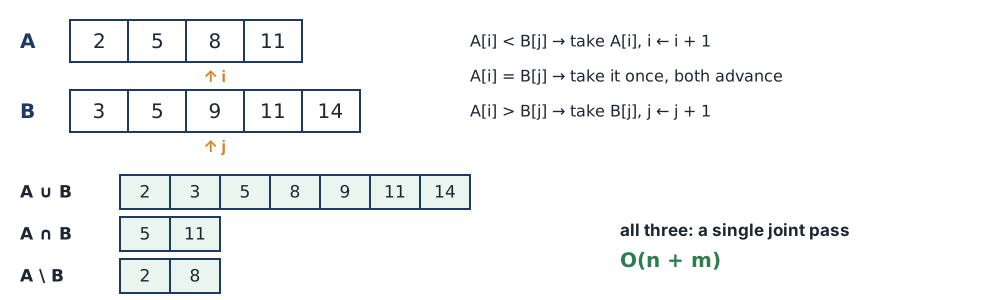
- **Set operations:** **merging** the two sorted arrays – a single joint pass
---
## Merging: the basis of the set operations
---
## Union by merging
Pseudocode
```text
Procedure Union(A, n, B, m, C, k)
i ← 1 ; j ← 1 ; k ← 0
While i ≤ n and j ≤ m
k ← k + 1
If A[i] < B[j] then
C[k] ← A[i] ; i ← i + 1
else if A[i] > B[j] then
C[k] ← B[j] ; j ← j + 1
else // equal
C[k] ← A[i] ; i ← i + 1 ; j ← j + 1
End if
End while
While i ≤ n // rest of A
k ← k + 1 ; C[k] ← A[i] ; i ← i + 1
End while
While j ≤ m // rest of B
k ← k + 1 ; C[k] ← B[j] ; j ← j + 1
End while
End procedure
```
Java
```java
int i = 0, j = 0, k = 0;
while (i < a.length && j < b.length) {
if (a[i] < b[j]) c[k++] = a[i++];
else if (a[i] > b[j]) c[k++] = b[j++];
else { c[k++] = a[i++]; j++; }
}
while (i < a.length) c[k++] = a[i++];
while (j < b.length) c[k++] = b[j++];
```
**Intersection:** write into C only in the equal branch, do not copy the rest.
**Difference:** write only in the `A[i] < B[j]` branch, and copy the rest of A.
---
## Subset by merging
```text
Function Subset(A, n, B, m) // A ⊆ B ?
i ← 1 ; j ← 1
While i ≤ n and j ≤ m and A[i] ≥ B[j]
If A[i] = B[j] then i ← i + 1
j ← j + 1
End while
Return i > n
End function
```
- If `A[i] < B[j]`, then A[i] is **certainly not** in B (the further elements of B are even larger) → not a subset
- Steps: **O(n + m)**
---
## Comparing the representations
| Operation | Boolean vector | Unsorted array | Sorted array |
|---|---|---|---|
| membership | **O(1)** | O(n) | O(log n) |
| insertion, deletion | **O(1)** | O(n) | O(n) |
| subset | O(\|U\|) | O(n · m) | **O(n + m)** |
| union, intersection, difference | O(\|U\|) | O(n · m) | **O(n + m)** |
| space | \|U\| bits | n elements | n elements |
| precondition | small, known U | – | sortable elements |
There is no “best” representation: the choice depends on the **size of the universe** and on the **most frequent operations**.
---
## Built-in sets
Java
```java
Set a = new HashSet<>(); // O(1) avg.
a.add("Wuhan");
a.contains("Wuhan"); // true
a.remove("Wuhan");
Set u = new HashSet<>(a);
u.addAll(b); // union
u.retainAll(b); // intersection
u.removeAll(b); // difference
TreeSet t = new TreeSet<>(); // O(log n)
t.first(); t.last(); // sorted!
```
Go – no set type, use a map
```go
type Set map[string]struct{}
s := Set{}
s["Wuhan"] = struct{}{} // insertion
_, ok := s["Wuhan"] // membership
delete(s, "Wuhan") // deletion
// common shortcut:
seen := map[int]bool{}
if !seen[x] {
seen[x] = true
}
```
`HashSet` and Go `map`: **hash table** (week 11) · `TreeSet`: **balanced search tree** (week 15)
---
## Summary
- **Set:** an unordered collection of distinct elements; operations: ∈, ⊆, ∪, ∩, \
- **Boolean vector / bit mask:** the fastest for a small, known universe – O(1), O(|U|)
- **Unsorted array:** simple, but the set operations are O(n · m)
- **Sorted array:** binary search O(log n), set operations by **merging** in O(n + m)
- Built-in: Java `HashSet` / `TreeSet`, Go `map[T]struct{}`
**Next week:** the stack – the LIFO principle, array implementation, evaluating postfix expressions.
---
## Review questions
1. The universe is U = {1, 2, …, 8}. Write as boolean vectors: A = {2, 3, 5, 7}, B = {1, 2, 3, 4}! Compute A ∪ B, A ∩ B, A \ B!
2. True or false: with the unsorted array representation, intersection takes O(n + m) steps.
3. Perform the merging on paper: A = [1, 4, 6, 9], B = [2, 4, 9, 10]! Give A ∪ B, A ∩ B and A \ B!
4. Why is it not practical to represent the set of student IDs (8-digit numbers) by a boolean vector?
5. With bit masks: `a = 0b1010`, `b = 0b0110`. What are `a & b`, `a | b`, `a & ~b`?
---
# Practice
---
## Demo programs
| Program | Java | Go | What does it show? |
|---|---|---|---|
| Boolean vector | `BitVectorSet.java` | `w06/bitvectorset` | a set of days, bit mask operations |
| Unsorted | `UnorderedSet.java` | `w06/unorderedset` | O(n · m) operations, deletion with the last element |
| Sorted | `SortedSet.java` | `w06/sortedset` | binary search, merging |
| Built-in | `BuiltinSets.java` | `w06/builtin` | `HashSet`, `TreeSet`, Go `map` |
---
## Exercises
1. **Removing duplicates:** make a set from an array by sorting! (`[4,1,4,2,1] → [1,2,4]`)
2. **Symmetric difference:** A △ B = (A \ B) ∪ (B \ A) – on sorted arrays, with a single merge!
3. **Disjoint?** Decide in O(n + m) steps whether two sorted sets have no common element!
4. **Power set:** print every subset of an *n*-element set using bit masks! How many are there?
5. **Distinct letters:** how many different English letters occur in a text? (boolean vector)
6. **Pangram:** does a sentence contain every letter of the English alphabet?
7. **Common friends:** the intersection of two friend lists using a built-in set (map).
Solutions: `Exercises06.java`, `w06/exercises`
---
## Homework
1. Implement a `SortedSet` class with `add(x)` and `remove(x)` operations that always stays sorted! (Hint: find the position by binary search.)
2. **Multiset** (bag): an element may occur several times. How would you represent it instead of a boolean vector? Implement union and intersection (maximum and minimum of the counts)!
3. Compute the intersection of three sorted sets with a **single** joint pass!
4. In an array of 1 000 000 numbers between 1 and 100 000, how many **distinct** numbers are there? Solve it with a boolean vector and compare it with the sorting-based solution!