---
marp: true
theme: kurzus
paginate: true
footer: Data Structures · Week 7 · Stack
---
# Data Structures
## Week 7 – The stack: LIFO principle, implementation, applications
Dr. Ferenc Koczka · Eszterházy Károly University · 2026
---
## Review
- **Array:** direct access, insertion and deletion at the end are **O(1)**
- **Abstract data type (ADT):** *what* it can do, not *how* (week 1)
- **Set:** different representations, different efficiency
### Questions for today
- What is a stack, and why is it so important?
- How can it be implemented with an array?
- How does a computer evaluate an expression like `(3 + 4) * 2`?
---
## The concept of a stack
A **stack** is a data structure in which only the **most recently inserted** element is accessible.
**LIFO** – *Last In, First Out*: what went in last comes out first.
### Everyday examples
- A pile of plates
- A Pringles chips can
- The “Back” button of a browser
- “Undo” in a text editor (Ctrl+Z)
### Properties
| | |
|---|---|
| Elements | homogeneous |
| Relationship | linear |
| Access | **restricted** – only the top |
| Size | static or dynamic |
---
## Stack operations
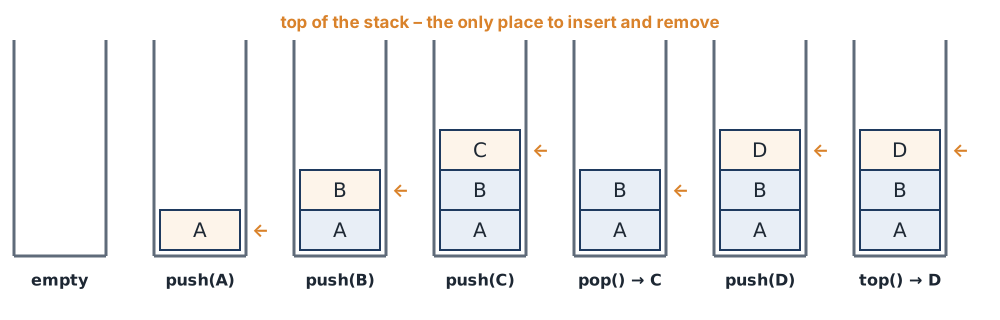
---
## Stack operations – summary
| Operation | Meaning | Steps |
|---|---|---|
| **Create** | empty stack | O(1) |
| **Push** | element onto the top | O(1) |
| **Pop** | removing and returning the top | O(1) |
| **Top / Peek** | reading the top without removing it | O(1) |
| **IsEmpty?** · **IsFull?** | querying the state | O(1) |
---
## Invalid operations
- **Pop or Top on an empty stack** → *underflow* (stack underflow)
- **Push onto a full stack** → *overflow* (stack overflow) – only for a fixed-size stack
Before the operations, always check **IsEmpty?** / **IsFull?** – or let the implementation signal the error (Java: exception, Go: `error` return value).
This is where the name *Stack Overflow* comes from: with too deep recursion the program's **call stack** fills up (see later and week 12).
---
# Implementation with an array
---
## Stack with an array
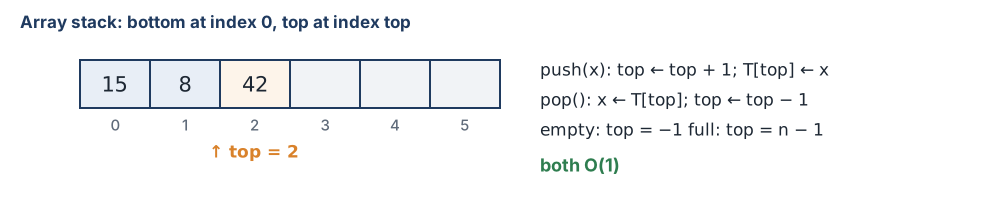
- The **bottom** of the stack is the beginning of the array, the **top** is at index `top`
- Push and Pop work at the **end** of the array → no elements need to be moved → **O(1)**
---
## Stack with an array – pseudocode
```text
// array T[1..n], top: index of the last element
Procedure Create
top ← 0
End procedure
Function IsEmpty
Return top = 0
End function
Function IsFull
Return top = n
End function
```
```text
Procedure Push(x)
If IsFull then ERROR("overflow")
else
top ← top + 1
T[top] ← x
End if
End procedure
Function Pop
If IsEmpty then ERROR("underflow")
else
x ← T[top]
top ← top − 1
Return x
End if
End function
```
The pseudocode indexes from 1, so for an empty stack top = 0; in Java/Go we index from 0, so an empty stack has top = −1.
---
## Stack with an array – Java and Go
Java
```java
class ArrayStack {
private final int[] data;
private int top = -1;
ArrayStack(int capacity) {
data = new int[capacity];
}
boolean isEmpty() { return top == -1; }
boolean isFull() { return top == data.length - 1; }
void push(int x) {
if (isFull())
throw new IllegalStateException("full");
data[++top] = x;
}
int pop() {
if (isEmpty())
throw new IllegalStateException("empty");
return data[top--];
}
}
```
Go – generic, with a slice
```go
type Stack[T any] struct {
items []T
}
func (s *Stack[T]) Push(x T) {
s.items = append(s.items, x)
}
func (s *Stack[T]) Pop() T {
n := len(s.items) - 1
x := s.items[n]
s.items = s.items[:n]
return x
}
func (s *Stack[T]) IsEmpty() bool {
return len(s.items) == 0
}
```
A slice is a dynamic array → there is no “full” state.
---
## Built-in stacks
Java
```java
Deque st = new ArrayDeque<>();
st.push(1);
st.push(2);
st.peek(); // 2
st.pop(); // 2
st.isEmpty(); // false
```
Instead of the old `java.util.Stack` class, **`ArrayDeque`** is recommended (faster).
Go
```go
st := []int{}
st = append(st, 1) // push
st = append(st, 2)
top := st[len(st)-1] // peek
st = st[:len(st)-1] // pop
empty := len(st) == 0
```
Go has no separate stack type – a **slice** is perfectly suitable.
---
# Application: evaluating expressions
---
## Infix, prefix, postfix
| Notation | Example | Position of the operator |
|---|---|---|
| **Infix** | `(3 + 4) * 2` | between the operands – parentheses needed |
| **Prefix** (Polish) | `* + 3 4 2` | before the operands |
| **Postfix** (reverse Polish) | `3 4 + 2 *` | after the operands |
**Advantages of postfix:**
- **No parentheses** and no precedence rules needed
- Can be evaluated from left to right, in **a single pass**, with one stack
- Compilers, the Java virtual machine and HP calculators work this way
---
## Evaluating postfix with a stack
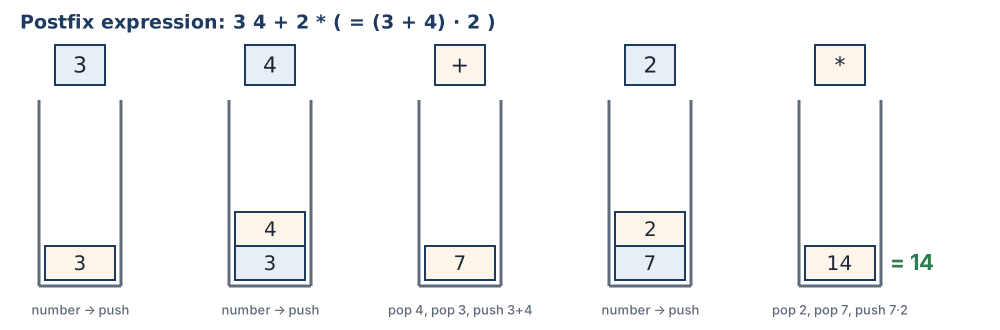
---
## Evaluating postfix – algorithm
Pseudocode
```text
Function PostfixValue(expression)
Create
For every token t from left to right
If t is a number then
Push(t)
else // t is an operator
b ← Pop // right operand!
a ← Pop // left operand
Push(a t b)
End if
End for
Return Pop
End function
```
The **right** operand comes out first! `5 2 -` → b = 2, a = 5 → 5 − 2 = 3
Java
```java
ArrayDeque st = new ArrayDeque<>();
for (String t : expr.split("\\s+")) {
if (isOperator(t)) {
double b = st.pop();
double a = st.pop();
st.push(apply(a, b, t));
} else {
st.push(Double.parseDouble(t));
}
}
return st.pop();
```
**Steps:** O(n) – every token is processed once
**Invalid expression:** Pop on an empty stack, or not exactly one element left at the end
---
## Example: `1 2 + 3 4 * - 9 /`
| Token | Operation | Stack (from the bottom) |
|---|---|---|
| 1 | push | 1 |
| 2 | push | 1 2 |
| + | 1 + 2 | 3 |
| 3 | push | 3 3 |
| 4 | push | 3 3 4 |
| * | 3 · 4 | 3 12 |
| − | 3 − 12 | −9 |
| 9 | push | −9 9 |
| / | −9 / 9 | **−1** |
In infix form: ((1 + 2) − 3 · 4) / 9 = −1
---
## From infix to postfix: the shunting-yard algorithm
**E. W. Dijkstra** (1961), simplified version – the **operators** go onto the stack:
1. **Operand** → straight to the output
2. **`(`** → onto the stack
3. **`)`** → everything from the stack to the output up to the first `(`; the `(` is discarded
4. **Operator** → while the top of the stack holds an operator **at least as strong**, move it to the output; then push the new operator
5. At the end, move the rest of the stack to the output
| Infix | Postfix |
|---|---|
| `3 + 4 * 2` | `3 4 2 * +` |
| `(3 + 4) * 2` | `3 4 + 2 *` |
| `(a + b) * (c − d)` | `a b + c d − *` |
---
## Application: checking brackets
Are the brackets correct? `{[()()]}` ✓ · `([)]` ✗ · `((a + b)` ✗
```text
Function Balanced(S)
Create
For every character c
If c is an opening bracket then Push(c)
else if c is a closing bracket then
If IsEmpty then Return false // no opening pair
If Pop is not the pair of c then Return false
End if
End for
Return IsEmpty // anything left unclosed?
End function
```
Applications: compilers, text editors, checking HTML/XML · **O(n)**
---
## Application: the call stack
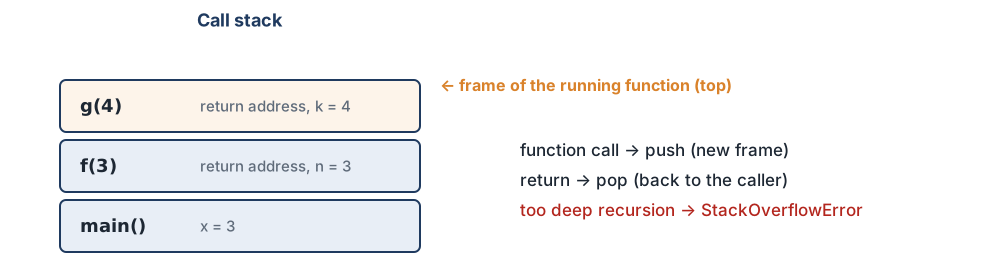
Every function call pushes a **frame** (local variables, parameters, return address) onto the stack – this is what makes **recursion** work (week 12).
---
## Further applications
- **Undo:** the state before every modification is pushed onto a stack
- **Browser history:** “Back” = pop, new page = push
- **Backtracking:** maze, sudoku, 8 queens – the decisions so far are on the stack
- **Depth-first traversal** of trees and graphs
- **Base conversion:** the remainders in reverse order → stack
- **Reversing text:** push every character, then pop them all
---
## Summary
- **Stack:** LIFO – only the top is accessible
- Operations: **Push, Pop, Top, IsEmpty?, IsFull?** – all **O(1)**
- **Array implementation:** a `top` index at the end of the array; overflow is possible with a fixed size
- Java: `ArrayDeque` · Go: slice (`append`, `s[:len(s)-1]`)
- **Postfix evaluation:** one pass, one stack, O(n) – the right operand comes out first!
- Applications: brackets, undo, call stack, backtracking
**Next week:** the queue – FIFO principle, circular queue, double-ended queue, priority queue.
---
## Review questions
1. What does it print? `push(1); push(2); pop(); push(3); push(4); pop(); pop(); pop();` (pop prints the element)
2. Evaluate with a stack, writing down the state of the stack after every step: `6 2 / 3 1 - *`
3. Convert to postfix form: `a * (b + c) - d / e`
4. What does the following code print for `n = 50`? What does it do in general?
`while (n > 0) { s.push(n % 2); n = n / 2; } while (!s.isEmpty()) print(s.pop());`
5. True or false: in the array implementation, Pop takes O(n) steps because the elements must be shifted.
---
# Practice
---
## Demo programs
| Program | Java | Go | What does it show? |
|---|---|---|---|
| Array stack | `ArrayStack.java` | `w07/arraystack` | push, pop, overflow/underflow, generic stack |
| Postfix | `Postfix.java` | `w07/postfix` | evaluation, printing the state of the stack |
| Infix → postfix | `InfixToPostfix.java` | `w07/infixtopostfix` | shunting-yard algorithm |
| Brackets | `Brackets.java` | `w07/brackets` | checking `()`, `[]`, `{}` |
---
## Exercises
1. **Binary form:** convert a decimal number to binary with a stack!
2. **Reversing:** reverse a text with a stack! (In Go, Chinese text too!)
3. **Min-stack:** implement a stack whose `min()` operation is O(1) too!
4. **Undo:** simulate the undo function of a text editor!
5. **Code tracing:** letter = push, `*` = pop and print. What does it print? `D A T * A * S * T R * U C * T`
6. **Neighbouring pairs:** repeatedly delete neighbouring equal letter pairs! (`"abbaca" → "ca"`)
Solutions: `Exercises07.java`, `w07/exercises`
---
## Homework
1. Extend the postfix evaluator with the `^` (power) and `%` (remainder) operators!
2. Extend the infix → postfix converter for **multi-digit numbers** (e.g. `12 + 345 * 6`)!
3. Write a program that implements a **queue** (FIFO) using two stacks! How many steps do the operations take?
4. Write a program that checks whether the tags (`…`, `…`) in an HTML text are correctly nested!