---
marp: true
theme: kurzus
paginate: true
footer: Data Structures · Week 8 · Queue
---
# Data Structures
## Week 8 – The queue: FIFO principle, circular queue, double-ended queue, priority queue
Dr. Ferenc Koczka · Eszterházy Károly University · 2026
---
## Review
- **Stack:** LIFO – only the top is accessible
- Push, Pop, Top – all **O(1)**, with an array at the end of the array
- Applications: postfix evaluation, brackets, undo, call stack
### Questions for today
- What is the difference between a stack and a queue?
- Why is the “naive” array queue bad, and how does the **circular** queue fix it?
- What are the double-ended queue and the priority queue?
---
## The concept of a queue
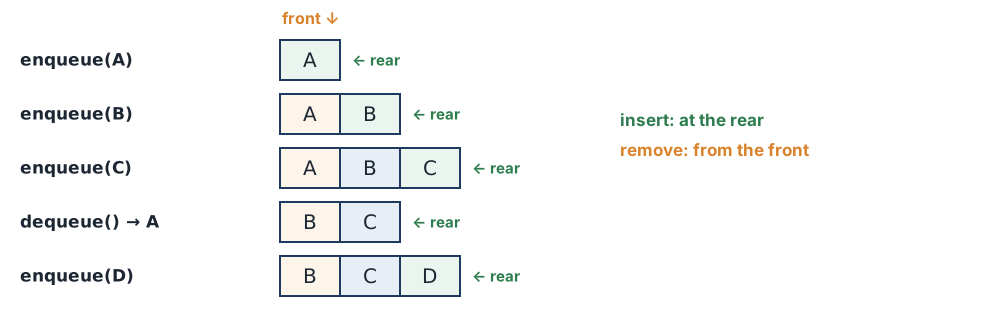
A **queue** is a data structure into which we insert at the **rear** and from which we remove at the **front**.
**FIFO** – *First In, First Out*: what went in first comes out first.
### Everyday examples
- Queuing in the canteen, at the checkout
- Print queue
- Customer service phone line
- Keyboard buffer
### Properties
| | |
|---|---|
| Elements | homogeneous |
| Relationship | linear |
| Access | **restricted** – front and rear |
| Size | static or dynamic |
---
## Queue operations
| Operation | Meaning | Steps |
|---|---|---|
| **Enqueue** | element to the **rear** of the queue | O(1) |
| **Dequeue** | removing the **front** element | O(1) |
| **Peek / Front** | reading the front element | O(1) |
| **IsEmpty?** · **IsFull?** | state | O(1) |
---
## Stack and queue compared
| | Stack | Queue |
|---|---|---|
| Principle | **LIFO** | **FIFO** |
| Insertion | onto the top (push) | at the rear (enqueue) |
| Removal | from the top (pop) | from the front (dequeue) |
| Access | one end | two ends |
| Pointers in the array implementation | `top` | `front`, `rear` |
| Typical application | undo, recursion, expressions | scheduling, buffering, breadth-first traversal |
---
# Queue with an array
---
## First attempt: the naive array queue
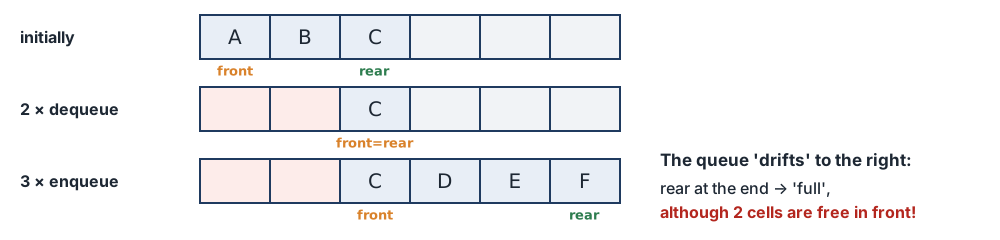
`front` is the index of the first, `rear` of the last element; enqueue: `rear ← rear + 1`, dequeue: `front ← front + 1`
---
## Ways to fix the naive queue
**1. Shifting:** after every dequeue the elements are shifted forward by one
- The front always stays 0, no space is lost
- But dequeue becomes **O(n)** ✗
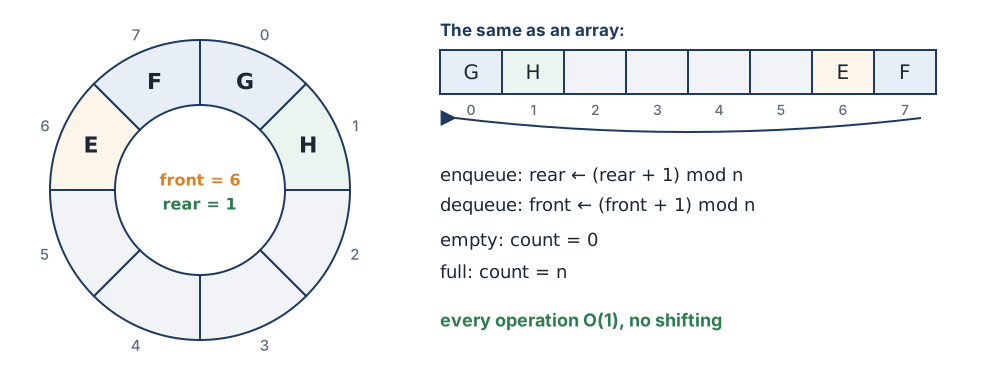
**2. Circular queue:** the array is treated as a **ring** – when `rear` reaches the end of the array, it continues at the **beginning**
- No element moves, every operation is **O(1)** ✓
- “Wrapping around” the index: **(i + 1) mod n**
---
## Circular queue
---
## Empty or full? The pitfall of the circular queue
With only `front` and `rear`, an **empty** and a **full** queue look the same: `front = (rear + 1) mod n`!
**Solutions:**
1. Keep track of the **count** (`count`) – empty: `count = 0`, full: `count = n` ← *we use this*
2. **One slot always stays empty** – full: `(rear + 1) mod n = front`, but only *n* − 1 elements fit
3. A boolean flag (`empty`) set by the operations
The counter-based solution is the simplest and the least error-prone.
---
## Circular queue – pseudocode
```text
// array T[0..n−1] (here exceptionally from 0,
// so that mod n is simple)
Procedure Create
front ← 0 ; rear ← n − 1 ; count ← 0
End procedure
Function IsEmpty
Return count = 0
End function
Function IsFull
Return count = n
End function
```
```text
Procedure Enqueue(x)
If IsFull then ERROR("the queue is full")
rear ← (rear + 1) mod n
T[rear] ← x
count ← count + 1
End procedure
Function Dequeue
If IsEmpty then ERROR("the queue is empty")
x ← T[front]
front ← (front + 1) mod n
count ← count − 1
Return x
End function
```
---
## Circular queue – Java and Go
Java
```java
class CircularQueue {
private final int[] data;
private int front = 0, rear = -1, count = 0;
void enqueue(int x) {
if (count == data.length)
throw new IllegalStateException("full");
rear = (rear + 1) % data.length;
data[rear] = x;
count++;
}
int dequeue() {
if (count == 0)
throw new IllegalStateException("empty");
int x = data[front];
front = (front + 1) % data.length;
count--;
return x;
}
}
```
Go
```go
type CircularQueue struct {
data []int
front, rear, count int
}
func (q *CircularQueue) Enqueue(x int) error {
if q.count == len(q.data) {
return errors.New("full")
}
q.rear = (q.rear + 1) % len(q.data)
q.data[q.rear] = x
q.count++
return nil
}
func (q *CircularQueue) Dequeue() (int, error) {
if q.count == 0 {
return 0, errors.New("empty")
}
x := q.data[q.front]
q.front = (q.front + 1) % len(q.data)
q.count--
return x, nil
}
```
---
## Built-in queues
Java
```java
Queue q = new ArrayDeque<>();
q.offer("Li"); // enqueue
q.offer("Wang");
q.peek(); // "Li"
q.poll(); // "Li" – dequeue
q.isEmpty();
```
Internally `ArrayDeque` is a **circular, dynamically growing** array.
Go
```go
q := []string{}
q = append(q, "Li") // enqueue
q = append(q, "Wang")
first := q[0] // peek
q = q[1:] // dequeue
```
Simple, but `q[1:]` does not free the beginning – for many operations an own circular queue or `container/list` is better.
---
# Variants of the queue
---
## Double-ended queue (deque)

- **Deque** (*double-ended queue*, pronounced “deck”): we can **insert** and **remove** at both ends
- Using only one end it is a **stack**, using opposite ends it is a **queue**
- With a circular array: for `addFirst`, `front ← (front − 1 + n) mod n`
In Java and Go the value of `-1 % n` is **−1**, not *n* − 1! That is why `+ n` is needed.
---
## Priority queue
Every element has a **priority**; we always remove the **most important** element (e.g. the one with the smallest priority number) – not the oldest one.
Examples: hospital emergency care, process scheduling in operating systems, route planning (Dijkstra)
| Implementation | Insertion | Removing the min |
|---|---|---|
| unsorted array | **O(1)** – at the end | O(n) – minimum search |
| sorted array | O(n) – shifting into place | **O(1)** – from the end |
| **heap** (week 15) | **O(log n)** | **O(log n)** |
Built-in: Java `PriorityQueue` · Go `container/heap`
---
## Applications
- **Buffering:** keyboard, network packets, video streaming – balancing the different speeds of producer and consumer
- **Scheduling:** print queue, the **round-robin** scheduler of operating systems
- **Simulation:** checkouts, traffic, service systems
- **Breadth-first traversal** (BFS): level-by-level traversal of trees, shortest paths in graphs
- **Message queues** in distributed systems (e.g. processing the orders of an online shop)
**Round-robin:** every process runs for at most one time slice and then goes to the rear of the queue – so everybody gets a turn.
---
## Summary
- **Queue:** FIFO – insert at the rear, remove at the front
- Operations: **Enqueue, Dequeue, Peek, IsEmpty?, IsFull?** – all **O(1)**
- **Naive array queue:** the queue “drifts”, space is lost at the front
- **Circular queue:** `(i + 1) mod n` – wraps around, no shifting; empty/full: **count**
- **Deque:** insertion and removal at both ends
- **Priority queue:** the most important element comes out first – O(log n) with a heap
**Next week:** dynamic data structures – a model of dynamic memory management and the singly linked list.
---
## Review questions
1. What does it print? `enqueue(1); enqueue(2); dequeue(); enqueue(3); enqueue(4); dequeue(); dequeue(); dequeue();`
2. Circular queue, n = 5, initially empty (front = 0, rear = 4). We perform: 4 × enqueue, 3 × dequeue, 3 × enqueue. What are `front`, `rear` and `count` now?
3. What does the following code print for n = 10? What does it do in general?
`q.enqueue(0); q.enqueue(1); for (i = 0; i < n; i++) { a = q.dequeue(); print(a); b = q.peek(); q.enqueue(a + b); }`
4. True or false: in a circular queue dequeue is O(n), because the elements must be shifted forward.
5. Which data structure would you use for: a) the “Back” button of a browser, b) print jobs, c) hospital emergency admission?
---
# Practice
---
## Demo programs
| Program | Java | Go | What does it show? |
|---|---|---|---|
| Naive queue | `NaiveQueue.java` | – | the problem of the “drifting” queue, fix by shifting |
| Circular queue | `CircularQueue.java` | `w08/circularqueue` | wrapping around, empty/full with a counter |
| Deque | `CircularDeque.java` | `w08/deque` | both ends, palindrome check |
| Priority queue | `PriorityQueueDemo.java` | `w08/priorityqueue` | with an unsorted array and with a heap |
---
## Exercises
1. **Code tracing:** run the code of review question 3, and explain the output!
2. **Josephus problem:** *n* people stand in a circle, every *k*-th person is eliminated. Who remains last? (With a queue: send k − 1 people to the rear, the *k*-th is eliminated.)
3. **Round-robin:** simulate the scheduling! Processes: P1 = 5, P2 = 2, P3 = 4 time units, time slice = 2. When does each process finish?
4. **Reversing a queue** with the help of a stack.
5. **Code tracing:** letter = enqueue, `*` = dequeue and print: `D A T * A * S * T R * U C * T` (compare with the stack!)
6. **Moving average:** after every new data item, print the average of the last *k* items in O(1) steps!
Solutions: `Exercises08.java`, `w08/exercises`
---
## Homework
1. Implement the circular queue **without a counter**, keeping one slot empty! How many elements fit into an array of size *n*?
2. Extend the circular queue so that, when full, it copies the elements into an array **twice as large** (dynamic circular queue)! Pay attention to the order of the wrapped-around elements!
3. Implement a **queue with two stacks** (see the homework of week 7)! Compare it with the circular queue!
4. **Checkout simulation:** customers arrive randomly, a cashier serves one customer per minute. What is the average waiting time for different arrival rates?