---
marp: true
theme: kurzus
paginate: true
footer: Data Structures · Week 9 · Dynamic memory, linked list
---
# Data Structures
## Week 9 – Dynamic data structures: a model of memory management and the singly linked list
Dr. Ferenc Koczka · Eszterházy Károly University · 2026
---
## Review
- So far our data structures were based on **arrays**: contiguous storage, direct access
- Stack, queue: we work at the **ends** of the array → O(1)
- **Pointer / reference** (week 1): a data item that stores a memory address
### Questions for today
- What are the limits of static (array-based) storage?
- How does a program allocate and free memory?
- How is a **linked list** built, and how fast are its operations?
---
## The limits of static data structures
- The size must be given **in advance** → too small or wasteful
- A **contiguous** free memory area is needed – for a large array this is not always available
- Insertion and deletion in the middle are **O(n)** – elements must be moved
- A dynamic array (week 3) helps, but on resizing **everything has to be copied**
**Idea:** store the elements **scattered**, anywhere in memory, and let every element **know where the next one is**.
---
# A model of dynamic memory management
---
## A simple model
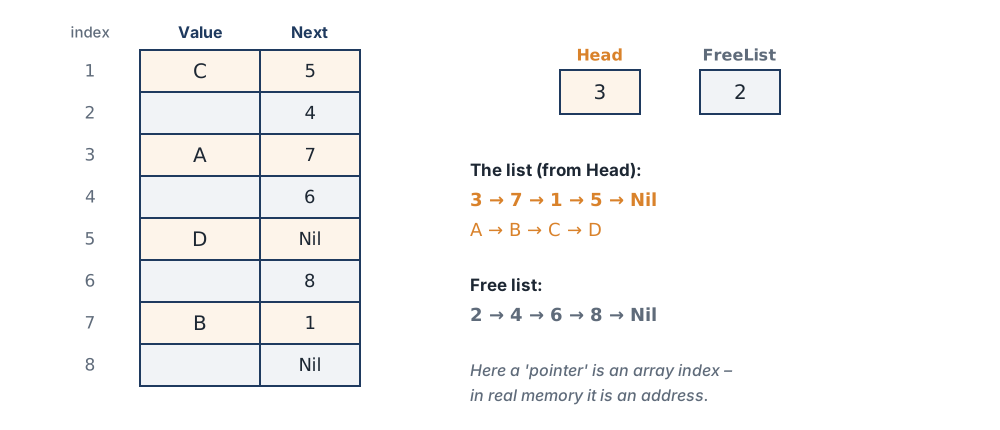
- **Memory** is a large array whose elements are records with a **Value** and a **Next** field
- A **pointer** is an **index** into this array – the special value **Nil** means “points nowhere”
- Notation: `Elem[P].Value`, `Elem[P].Next` – the fields of the element pointed to by P
---
## Reserving and freeing
The free slots are also kept in a **list** (FreeList).
```text
Function Reserve(P)
If FreeList = Nil then
Return false // memory is full
else
P ← FreeList
FreeList ← Elem[P].Next
Return true
End if
End function
```
```text
Procedure Free(P)
Elem[P].Next ← FreeList
FreeList ← P
End procedure
```
- Both are **O(1)**
- We take from the **front** of the free list and put back there – just like a stack!
In practice free memory is managed by the operating system and the runtime – in the old assignment its implementation could also be omitted.
---
## In reality
| | Allocation | Freeing |
|---|---|---|
| C | `p = malloc(sizeof(Node))` | `free(p)` – the programmer's responsibility |
| **Java** | `new Node(x)` | **automatic** – garbage collector (GC) |
| **Go** | `&Node{Value: x}` or `new(Node)` | **automatic** – garbage collector (GC) |
**Typical mistakes with manual memory management:**
- **Memory leak:** allocated memory is never freed → the program uses more and more memory
- **Dangling pointer:** we point to freed memory and use it
- The garbage collector prevents these: whatever **nothing points to** any more is freed
---
## Dynamic data structures: advantages and costs
**Advantages**
- They use as much memory as **currently needed** → memory can be **shared** between several data structures (resource sharing)
- No contiguous memory area is needed
- Insertion and deletion by **changing pointers**, without moving elements
**Costs**
- Every element also stores **one or more pointers** → more memory
- **No direct access** – to reach the *i*-th element we must walk through the previous ones
- Allocation/freeing and following pointers **take time**
---
# The singly linked list
---
## The structure of a linked list

- Every **element**: a value + a pointer to the **next** element
- **Head:** pointer to the first element · the `Next` field of the last element is **Nil**
- **Empty list:** Head = Nil
| Property | Linked list |
|---|---|
| Elements | homogeneous |
| Size | **dynamic** |
| Storage | **scattered** |
| Access | **sequential** |
---
## A list element in Java and Go
Java
```java
class Node {
int value;
Node next; // reference to the next one
Node(int value, Node next) {
this.value = value;
this.next = next;
}
}
Node head = null; // empty list
```
Go
```go
type Node struct {
Value int
Next *Node // pointer to the next one
}
type List struct {
Head *Node // nil: empty list
}
```
| Pseudocode | Java | Go |
|---|---|---|
| `Elem[P].Value` · `Elem[P].Next` | `p.value` · `p.next` | `p.Value` · `p.Next` |
| `Nil` · `Head` | `null` · `head` | `nil` · `l.Head` |
---
## Traversal and search
Traversal (processing)
```text
Procedure Traverse(Head)
P ← Head
While P ≠ Nil
Process(Elem[P].Value)
P ← Elem[P].Next
End while
End procedure
```
Search
```text
Function Search(Head, x)
P ← Head
While P ≠ Nil and Elem[P].Value ≠ x
P ← Elem[P].Next
End while
Return P // Nil if not found
End function
```
Java
```java
for (Node p = head; p != null; p = p.next)
System.out.println(p.value);
Node find(int x) {
Node p = head;
while (p != null && p.value != x)
p = p.next;
return p;
}
```
Go
```go
for p := l.Head; p != nil; p = p.Next {
fmt.Println(p.Value)
}
```
Both are **O(n)**. No binary search even in a sorted list – there is no direct access!
---
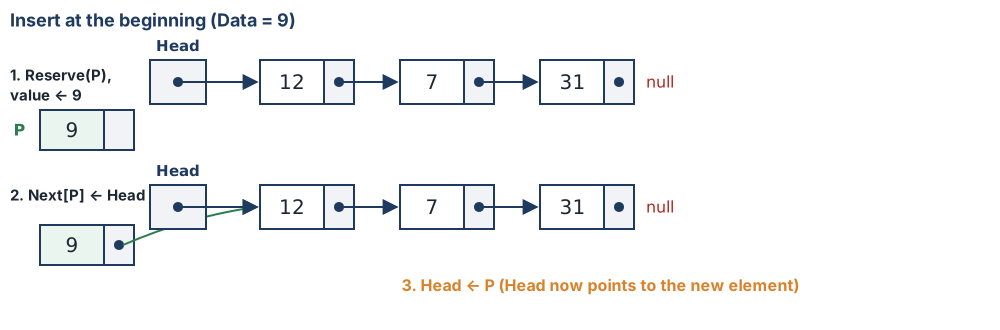
## Insertion at the beginning
---
## Insertion at the beginning and deletion from the beginning
Insertion at the beginning – O(1)
```text
Procedure InsertFirst(Head, Data)
If Reserve(P) then
Elem[P].Value ← Data
Elem[P].Next ← Head
Head ← P
else
ERROR("no free memory")
End if
End procedure
```
Deletion from the beginning – O(1)
```text
Procedure DeleteFirst(Head)
If Head ≠ Nil then
P ← Head
Head ← Elem[P].Next
Free(P)
End if
End procedure
```
Java
```java
void insertFirst(int x) {
head = new Node(x, head);
}
int removeFirst() {
int x = head.value;
head = head.next; // the GC frees it
return x;
}
```
Go
```go
func (l *List) InsertFirst(x int) {
l.Head = &Node{Value: x, Next: l.Head}
}
func (l *List) RemoveFirst() int {
x := l.Head.Value
l.Head = l.Head.Next
return x
}
```
---
## Insertion after a given element
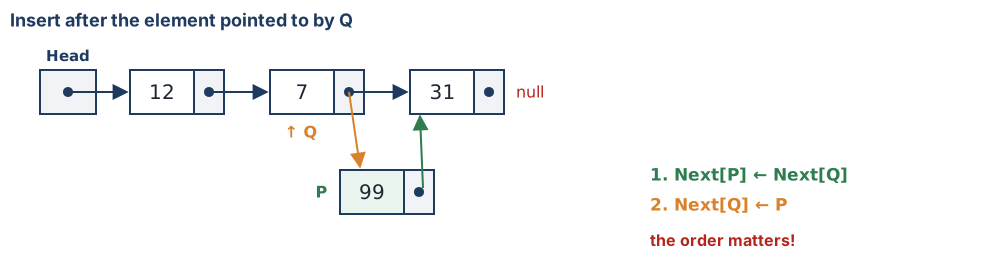
In the reverse order (`Next[Q] ← P` first) we would **lose** the rest of the list – nothing would point to it any more!
---
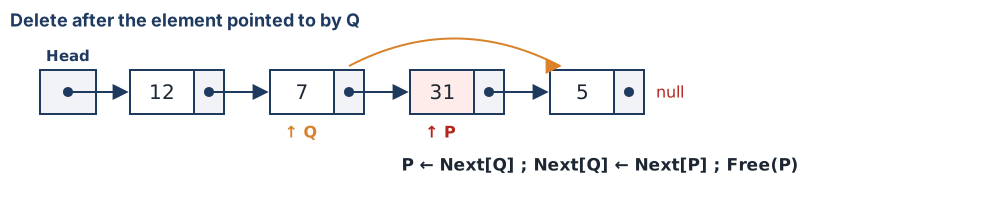
## Deletion after a given element
```text
Procedure InsertAfter(Q, Data)
If Reserve(P) then
Elem[P].Value ← Data
Elem[P].Next ← Elem[Q].Next
Elem[Q].Next ← P
End if
End procedure
```
```text
Procedure DeleteAfter(Q)
P ← Elem[Q].Next
If P ≠ Nil then
Elem[Q].Next ← Elem[P].Next
Free(P)
End if
End procedure
```
Both are **O(1)** – once we have Q. (Finding it is O(n).)
---
## Operations at the end of the list
Insertion at the end – O(n)
```text
Procedure InsertLast(Head, Data)
If Reserve(P) then
Elem[P].Value ← Data
Elem[P].Next ← Nil
If Head = Nil then
Head ← P
else
Q ← Head
While Elem[Q].Next ≠ Nil
Q ← Elem[Q].Next
End while
Elem[Q].Next ← P
End if
End if
End procedure
```
Deletion from the end – O(n)
```text
Procedure DeleteLast(Head)
If Head = Nil then exit
If Elem[Head].Next = Nil then
Free(Head) ; Head ← Nil
else
Q ← Head // we look for the last but one
While Elem[Elem[Q].Next].Next ≠ Nil
Q ← Elem[Q].Next
End while
Free(Elem[Q].Next)
Elem[Q].Next ← Nil
End if
End procedure
```
If we also keep an **End** pointer, insertion at the end becomes O(1) – deletion from the end does not (the last but one must still be found). Solution: doubly linked list (week 10).
---
## Deleting an element by value
In a singly linked list we can only delete the element **after** a known one → while searching we must also remember the **previous** element.
```java
boolean remove(int x) {
Node prev = null, p = head;
while (p != null && p.value != x) {
prev = p;
p = p.next;
}
if (p == null) return false; // no such element
if (prev == null) head = p.next; // deleting the first element
else prev.next = p.next;
return true;
}
```
Always think of the **special cases**: empty list, the first element, the last element, a one-element list!
---
## Linked list or array?
| Operation | Array | Dynamic array | Linked list |
|---|---|---|---|
| accessing the *i*-th element | **O(1)** | **O(1)** | O(n) |
| search | O(n) / O(log n) sorted | O(n) / O(log n) | O(n) |
| insertion / deletion at the beginning | O(n) | O(n) | **O(1)** |
| insertion / deletion after a known element | O(n) | O(n) | **O(1)** |
| insertion at the end | O(1) if there is room | O(1) amortized | O(n), O(1) with an End pointer |
| space per element | value | value (+ reserve) | value + **pointer** |
**Measurement** (inserting n = 160 000 elements at the beginning): `ArrayList` 870 ms · `LinkedList` 2 ms
**Reading the middle element** 20 000 times: `ArrayList` 0.1 ms · `LinkedList` 357 ms
---
## Summary
- **Dynamic data structure:** elements scattered in memory, connected by pointers; its size changes at run time
- **Memory model:** array of records + free list; `Reserve(P)`, `Free(P)` – in Java/Go `new` and the garbage collector
- **Linked list:** Head → element → element → … → Nil; **sequential** access
- At the beginning and after a known element: insertion and deletion **O(1)** · search, at the end: **O(n)**
- The **order** of changing pointers matters · special cases: empty list, first element
**Next week:** sentinel list, doubly linked list, circular list.
---
## Review questions
1. True or false: the use of dynamic data structures enables resource sharing.
2. True or false: the elements of a linked list can be accessed directly (by index).
3. True or false: improper use of dynamic data structures can result in memory leaks.
4. What happens if, when inserting after Q, first `Elem[Q].Next ← P` and then `Elem[P].Next ← Elem[Q].Next` is executed?
5. Write in pseudocode: insert the value `Data` at the **beginning** of the list given by the Head pointer! (`Reserve(P)` returns true if it succeeded.)
6. Why is deletion from the end of the list O(n), even if we know the End pointer?
---
# Practice
---
## Demo programs
| Program | Java | Go | What does it show? |
|---|---|---|---|
| Memory model | `MemoryModel.java` | `w09/memorymodel` | array of records, free list, Reserve/Free |
| Linked list | `SinglyLinkedList.java` | `w09/singlylist` | every basic operation |
| List vs. array | `ListVsArray.java` | – | insertion at the beginning, reading the middle element |
The `MemoryModel` program implements exactly the pseudocode of the lecture – follow the printed tables!
---
## Exercises
1. **Sum and maximum:** compute them with a single traversal!
2. **i-th element:** return the *i*-th element of the list! How many steps does it take?
3. **Counting:** how many times does *x* occur in the list?
4. **Reversing in place:** reverse the list by changing the pointers, without creating new elements!
5. **Deleting every x:** delete every element with value *x*! (Pay attention to the ones at the beginning!)
6. **Middle element:** with a single traversal – one pointer moves one step, the other moves two!
7. **Sorted insertion:** insert so that the list stays in increasing order!
Solutions: `Exercises09.java`, `w09/exercises`
---
## Homework
1. Extend the list with an **End** pointer! Which operations become faster, and which must be modified?
2. Merge two **sorted** linked lists into one sorted list without creating new elements, in O(n + m) steps!
3. Decide whether a list contains a **cycle** (the `Next` field of some element points to an earlier element)! (Hint: hare and tortoise.)
4. Implement a stack with a linked list (push = insertion at the beginning, pop = deletion from the beginning)! Why is this better than working at the end?