---
marp: true
theme: kurzus
paginate: true
footer: Data Structures · Week 12 · Recursion
---
# Data Structures
## Week 12 – Recursion: reducing a problem to a smaller instance of itself
Dr. Ferenc Koczka · Eszterházy Károly University · 2026
---
## Review
- **Call stack** (week 7): every function call pushes a frame onto the stack, returning pops it
- **Linked list:** one element + the rest of the list (which is also a list!)
- **Binary search:** we halve the problem and continue in the same way
### Questions for today
- What is recursion, and how does it work in the computer?
- How do we write a correct recursive function?
- When is recursion good, and when is it dangerous?
---
## What is recursion?
**Recursion:** a function **calls itself** on a **smaller** instance of the problem.
Every recursive function has two parts:
1. **Base case:** the simplest case, solved directly – here the recursion **stops**
2. **Recursive case:** the problem is reduced to a **smaller** instance of the same problem
**Factorial:** n! = 1 · 2 · … · n
0! = 1 *(base case)*
n! = n · (n − 1)! *(recursive case)*
In mathematics its counterpart is **mathematical induction**: if the base case is true, and the larger case follows from the smaller one, then it is true for every case.
---
## Factorial
Pseudocode
```text
Function Fact(n)
If n ≤ 1 then
Return 1 // base case
else
Return n · Fact(n − 1) // recursive case
End if
End function
```
Java
```java
static long fact(int n) {
if (n <= 1) return 1;
return n * fact(n - 1);
}
```
Go
```go
func fact(n int) int64 {
if n <= 1 {
return 1
}
return int64(n) * fact(n-1)
}
```
**Output of the program** (`Factorial`):
```text
fact(4) called
fact(3) called
fact(2) called
fact(1) called
fact(1) = 1
fact(2) = 2
fact(3) = 6
fact(4) = 24
```
---
## How does it work? The call stack
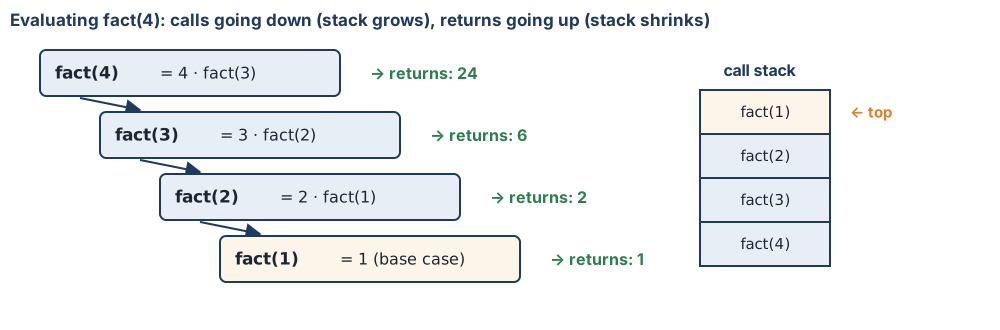
- Every call gets its own **frame**: its own parameter *n*, its own return address
- The multiplications are performed only **backwards** (while returning)
- Space: **O(n)** – n frames on the stack
---
## Correct recursion – three rules
1. **There is a base case** that gives a result without recursion
2. Every recursive call **gets closer** to the base case (smaller n, shorter list, smaller range)
3. **Trust the recursion:** assume that the call returns the correct result for the smaller problem, and only think about how the solution of the larger problem is built from it
Without a base case, or without getting closer to it: **infinite recursion** → the stack fills up
Java: `StackOverflowError` (after about 10 000–30 000 calls) · Go: the stack grows, but crashes at 1 GB
---
## Kinds of recursion
| Kind | Meaning | Example |
|---|---|---|
| **Direct** | f calls itself | factorial |
| **Indirect** | f calls g, g calls f | even(n) → odd(n − 1) |
| **Linear** | one recursive call | factorial, sum, length of a list |
| **Tree (multiple)** | several recursive calls | Fibonacci, Towers of Hanoi, tree traversal |
| **Tail recursion** | the recursive call is the last operation | `gcd(b, a mod b)` |
Tail recursion can be turned into a loop mechanically (some compilers do this automatically – Java and Go do not).
---
# Efficiency: the Fibonacci example
---
## Fibonacci numbers
**Definition:** F(0) = 0, F(1) = 1, F(n) = F(n − 1) + F(n − 2)
0, 1, 1, 2, 3, 5, 8, 13, 21, 34, 55, …
```text
Function Fib(n)
If n < 2 then
Return n
else
Return Fib(n − 1) + Fib(n − 2)
End if
End function
```
```java
static long fib(int n) {
if (n < 2) return n;
return fib(n - 1) + fib(n - 2);
}
```
Simple and follows the definition exactly – but…
---
## The call tree of the naive Fibonacci
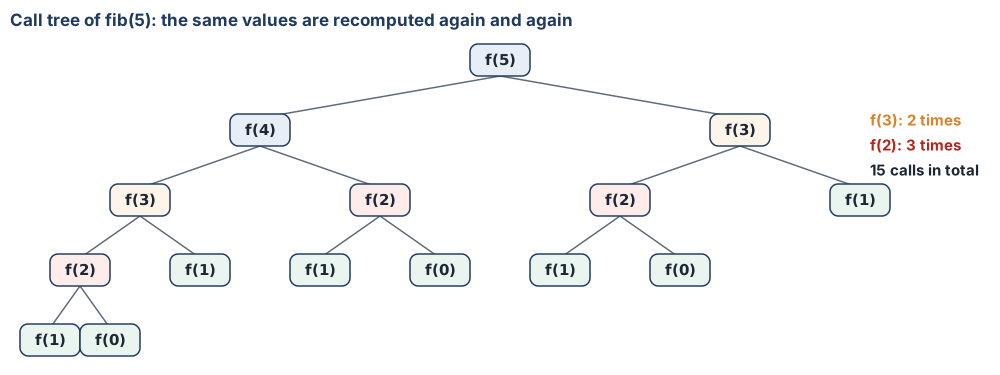
---
## Measurements
| n | fib(n) | naive calls | memoized | time (naive) |
|---|---|---|---|---|
| 10 | 55 | 177 | 19 | 0.0 ms |
| 20 | 6 765 | 21 891 | 39 | 0.1 ms |
| 30 | 832 040 | 2 692 537 | 59 | 2.6 ms |
| 40 | 102 334 155 | **331 160 281** | 79 | **320 ms** |
- The naive version is **exponential**: O(φⁿ) ≈ O(1.618ⁿ) – minutes for n = 50, millions of years for n = 100
- **Memoization:** the values already computed are stored in a **hash table** → **O(n)**
- **Iteration:** with two variables, O(n) time, **O(1)** space
---
## Improved versions
Memoization (Java)
```java
static HashMap memo = new HashMap<>();
static long fibMemo(int n) {
if (n < 2) return n;
Long cached = memo.get(n);
if (cached != null) return cached;
long r = fibMemo(n - 1) + fibMemo(n - 2);
memo.put(n, r);
return r;
}
```
Iteration (Go)
```go
func fibIter(n int) int {
a, b := 0, 1
for i := 0; i < n; i++ {
a, b = b, a+b
}
return a
}
```
Memoization is the basic idea of **dynamic programming**: every subproblem is solved only once.
---
# Classic examples
---
## Recursive thinking: “first + rest”
**Sum of an array:** the first element + the sum of the rest
```java
static int sum(int[] a, int from) {
if (from == a.length) return 0;
return a[from] + sum(a, from + 1);
}
```
**Reversing a string:** the rest reversed + the first character
```java
static String reverse(String s) {
if (s.isEmpty()) return s;
return reverse(s.substring(1)) + s.charAt(0);
}
```
**Palindrome:** the first = the last, and the inside is a palindrome too
```go
func isPalindrome(r []rune) bool {
if len(r) < 2 {
return true
}
return r[0] == r[len(r)-1] &&
isPalindrome(r[1:len(r)-1])
}
```
**Length of a linked list:** 1 + the length of the rest
```go
func length(p *Node) int {
if p == nil {
return 0
}
return 1 + length(p.Next)
}
```
---
## Fast exponentiation – divide and conquer
Computing x¹³ instead of 12 multiplications:
- x¹³ = (x⁶)² · x x⁶ = (x³)² x³ = (x¹)² · x → **5** multiplications in total
```text
Function Power(x, n)
If n = 0 then Return 1
half ← Power(x, n div 2)
If n mod 2 = 0 then Return half · half
else Return half · half · x
End function
```
- Every call **halves** n → **O(log n)** calls (like binary search)
- The same pattern: **recursive binary search**, merge sort, quicksort (week 13)
---
## Towers of Hanoi
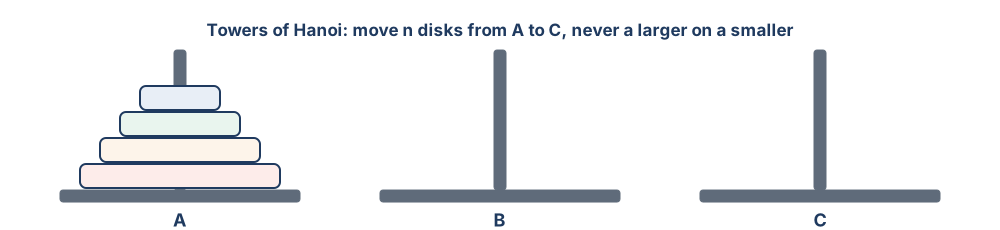
```text
Procedure Hanoi(n, from, to, via)
If n > 0 then
Hanoi(n − 1, from, via, to)
Move(from, to)
Hanoi(n − 1, via, to, from)
End if
End procedure
```
- Number of moves: **2ⁿ − 1** → O(2ⁿ)
- n = 3: 7 moves · n = 20: 1 048 575 moves
- n = 64: at one move per second about **585 billion years**
Much harder to write iteratively!
---
## Backtracking: permutations
All orders of `A, B, C`: ABC, ACB, BAC, BCA, CAB, CBA
```java
static void permute(List prefix, boolean[] used, char[] items) {
if (prefix.size() == items.length) { print(prefix); return; } // base case
for (int i = 0; i < items.length; i++) {
if (used[i]) continue;
used[i] = true; prefix.add(items[i]); // decision
permute(prefix, used, items); // the rest recursively
prefix.remove(prefix.size() - 1); used[i] = false; // backtracking
}
}
```
- n elements have **n!** permutations – O(n · n!)
- The same pattern: sudoku, maze, 8 queens, subsets
---
## Recursion or iteration?
| | Recursion | Iteration |
|---|---|---|
| Code | short, follows the definition | often longer |
| Space | O(depth) on the stack | usually O(1) |
| Speed | cost of the function calls | faster |
| Danger | stack overflow | – |
| Natural application | **trees**, divide and conquer, backtracking | simple loops, lists |
Every recursion can be rewritten as iteration (with an own **stack** if necessary), and vice versa.
**Rule of thumb:** if the problem is **tree-shaped** (several recursive calls), recursion is much simpler; if it is linear, rather write a loop.
---
## Summary
- **Recursion:** the function calls itself on a **smaller** problem
- Needed: a **base case** + the calls must **get closer** to the base case
- How it works: **call stack** – every call with its own frame, space O(depth)
- **Tree recursion** can easily become exponential (naive Fibonacci) → **memoization** or iteration
- Classic examples: factorial, exponentiation (O(log n)), Towers of Hanoi (2ⁿ − 1), permutations
- The natural tool of **trees** (weeks 14–15) and of the fast sorting algorithms (week 13)
**Next week:** sorting II – merge sort and quicksort.
---
## Review questions
1. What is the maximal depth of the call stack during the call `Fact(5)`?
2. What is wrong? `Function F(n): Return n + F(n − 1)`
3. How many times is the naive `Fib` function called while computing `Fib(5)`?
4. What does it print? `Procedure P(n): If n > 0 then P(n − 1); Print(n)` – `P(3)`
5. And if `Print(n)` is moved before `P(n − 1)`?
6. In how many moves can 5 disks be moved in the Towers of Hanoi?
---
# Practice
---
## Demo programs
| Program | Java | Go | What does it show? |
|---|---|---|---|
| Factorial | `Factorial.java` | `w12/factorial` | indented trace of the calls, overflow |
| Fibonacci | `Fibonacci.java` | `w12/fibonacci` | number of calls, memoization, time |
| Examples | `RecursionExamples.java` | `w12/examples` | sum, power, reverse, palindrome, binary search |
| Hanoi | `Hanoi.java` | `w12/hanoi` | printing the moves, 2ⁿ − 1 |
| Stack depth | `StackDepth.java` | `w12/stackdepth` | `StackOverflowError` in Java, growing stack in Go |
| Permutations | `Permutations.java` | `w12/permutations` | backtracking |
---
## Exercises
Solve them **with recursion** (without loops)!
1. **Digit sum:** `2026 → 10`
2. **Binary representation:** `50 → "110010"` (compare with the stack of week 7!)
3. **Maximum:** the largest element of an array
4. **Counting:** how many times does *x* occur in an array?
5. **List backwards:** print the elements of a linked list in reverse order!
6. **Length of a list** recursively
7. **Binomial coefficient:** C(n, k) = C(n − 1, k − 1) + C(n − 1, k) – why is it slow for large n?
Solutions: `Exercises12.java`, `w12/exercises`
---
## Homework
1. Write the binomial coefficient **with memoization**, and measure the speedup for C(30, 15)!
2. Write a recursive function that prints **all subsets** of a set! How many are there?
3. **Maze:** on a character map (`#` wall, `.` path) find a path from the top left corner to the bottom right one with backtracking!
4. Rewrite the Towers of Hanoi solution **iteratively** with an own stack! (Hint: push the “tasks still to be done” onto the stack.)