---
marp: true
theme: kurzus
paginate: true
footer: Data Structures · Week 13 · Sorting II
---
# Data Structures
## Week 13 – Sorting II: merge sort and quicksort
Dr. Ferenc Koczka · Eszterházy Károly University · 2026
---
## Review
- **Simple sorting algorithms** (week 5): bubble, selection, insertion – **O(n²)**
- **Merging** (weeks 3, 6): one sorted sequence from two sorted ones – **O(n + m)**
- **Recursion** (week 12): reducing the problem to smaller instances
### Questions for today
- How can we sort in O(n log n) time?
- What is the “divide and conquer” principle?
- Why is quicksort the favourite of practice – and when is it slow?
---
## Divide and conquer
**Divide and conquer** – three steps:
1. **Divide:** the problem is split into smaller subproblems of the same type
2. **Conquer:** the subproblems are solved **recursively** (very small ones directly)
3. **Combine:** the full solution is built from the partial solutions
| | Divide | Combine |
|---|---|---|
| **Merge sort** | trivial (cut in the middle) | **work:** merging |
| **Quicksort** | **work:** partitioning | trivial (nothing) |
| Binary search (week 2) | based on the middle element | – (only one half is examined) |
---
# Merge sort
---
## Merge sort – the idea
---
## The merge step
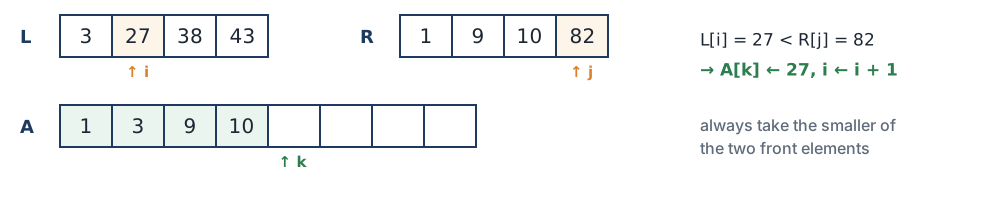
- One sorted array (A) from two **sorted** parts (L, R)
- We always move the smaller of the elements at the **front** of the two parts
- If one part runs out, the rest of the other is copied
- Steps: **O(n)**, extra space: **O(n)**
---
## Merge sort – algorithm
Pseudocode
```text
Procedure MergeSort(A, left, right)
If left < right then
k ← (left + right) div 2
MergeSort(A, left, k)
MergeSort(A, k + 1, right)
Merge(A, left, k, right)
End if
End procedure
Procedure Merge(A, left, k, right)
L ← A[left..k] ; R ← A[k+1..right] // copies
i ← 1 ; j ← 1 ; m ← left
While i ≤ length(L) and j ≤ length(R)
If L[i] ≤ R[j] then
A[m] ← L[i] ; i ← i + 1
else
A[m] ← R[j] ; j ← j + 1
End if
m ← m + 1
End while
copy the rest of L and R into A
End procedure
```
Java
```java
static void mergeSort(int[] a, int lo, int hi) {
if (lo >= hi) return;
int mid = lo + (hi - lo) / 2;
mergeSort(a, lo, mid);
mergeSort(a, mid + 1, hi);
merge(a, lo, mid, hi);
}
static void merge(int[] a, int lo, int mid, int hi) {
int[] l = Arrays.copyOfRange(a, lo, mid + 1);
int[] r = Arrays.copyOfRange(a, mid + 1, hi + 1);
int i = 0, j = 0, k = lo;
while (i < l.length && j < r.length)
a[k++] = (l[i] <= r[j]) ? l[i++] : r[j++];
while (i < l.length) a[k++] = l[i++];
while (j < r.length) a[k++] = r[j++];
}
```
---
## Merge sort – analysis
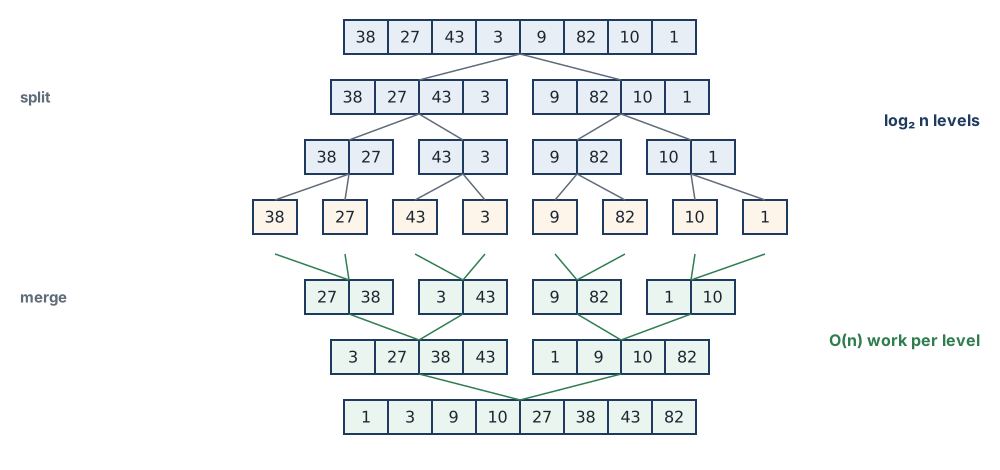
- Number of halvings: **log₂ n** levels
- On every level **n** elements are merged in total → **O(n)** per level
- In total: **O(n log n)** – in **every** case (best, average, worst)
| Property | Merge sort |
|---|---|
| Steps | **O(n log n)** always |
| Extra space | **O(n)** – does not sort in place |
| Stable | **yes** (`≤` in the merge) |
| On a linked list | works well (no direct access needed) |
For n = 10⁶: n² = 10¹² steps, n log₂ n ≈ 2 · 10⁷ steps – **50 000 times** fewer!
---
# Quicksort
---
## Quicksort – the idea
**C. A. R. Hoare** (1959)
1. Choose an element: the **pivot**
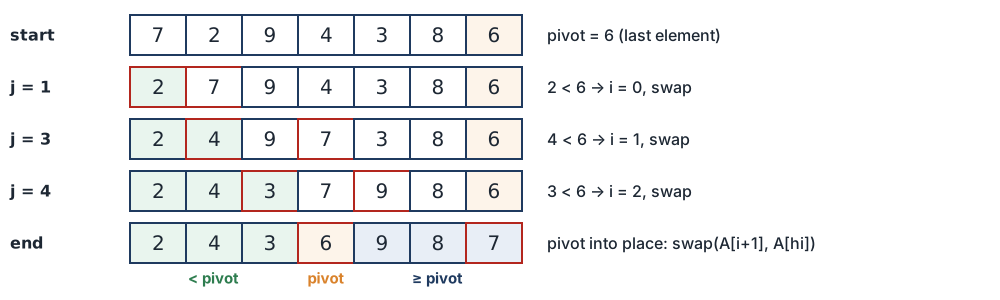
2. **Partitioning:** rearrange the array so that the elements **smaller** than the pivot go **left** and the **larger** ones go **right** – this way the pivot gets to its **final position**
3. Sort the left and the right part **recursively**
Unlike merge sort, here the **dividing** is the work, and combining is “free”: if both parts are sorted, the whole is sorted.
---
## Partitioning (Lomuto scheme)
---
## Quicksort – algorithm
Pseudocode
```text
Procedure QuickSort(A, left, right)
If left < right then
p ← Partition(A, left, right)
QuickSort(A, left, p − 1)
QuickSort(A, p + 1, right)
End if
End procedure
Function Partition(A, left, right)
pivot ← A[right]
i ← left − 1
For j ← left to right − 1
If A[j] < pivot then
i ← i + 1
swap(A[i], A[j])
End if
End for
swap(A[i + 1], A[right])
Return i + 1
End function
```
Java
```java
static void quickSort(int[] a, int lo, int hi) {
if (lo >= hi) return;
int p = partition(a, lo, hi);
quickSort(a, lo, p - 1);
quickSort(a, p + 1, hi);
}
static int partition(int[] a, int lo, int hi) {
int pivot = a[hi];
int i = lo - 1;
for (int j = lo; j < hi; j++)
if (a[j] < pivot) {
i++;
swap(a, i, j);
}
swap(a, i + 1, hi);
return i + 1;
}
```
---
## The importance of choosing the pivot
---
## Quicksort – analysis
| Case | When? | Steps |
|---|---|---|
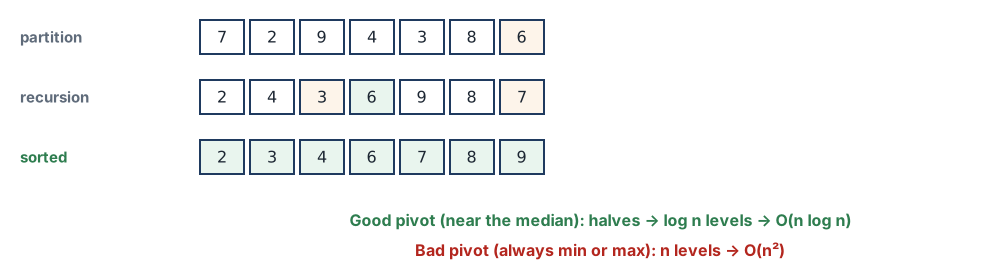
| Best | the pivot is always the median | O(n log n) |
| Average | random data | **O(n log n)** (~1.39 · n log₂ n comparisons) |
| Worst | the pivot is always the min. or the max. (e.g. a **sorted** array, last element as pivot) | **O(n²)** |
**Measurement** (n = 5000, sorted input): fixed pivot **12 497 500**, random pivot **68 648** comparisons
**Protection against the worst case:**
- **Random pivot** – the probability of the bad case is negligible
- **Median of three** (the median of the first, the middle and the last element)
- Recursion on the smaller part, a loop for the larger one → stack depth O(log n)
---
## Quicksort – properties
| Property | Quicksort |
|---|---|
| Steps | O(n log n) on average, O(n²) in the worst case |
| Extra space | **O(log n)** (the stack of the recursion) – sorts **in place** |
| Stable | **no** (because of the distant swaps) |
| In practice | usually the **fastest** – little data movement, cache-friendly |
Java `Arrays.sort` uses **Dual-Pivot Quicksort** for primitive arrays, Go `slices.Sort` uses **pdqsort** (an improved version of quicksort).
---
# Comparison
---
## Comparison of the sorting algorithms
| | Worst | Average | Best | Extra space | Stable |
|---|---|---|---|---|---|
| Bubble | O(n²) | O(n²) | O(n) | O(1) | yes |
| Selection | O(n²) | O(n²) | O(n²) | O(1) | no |
| Insertion | O(n²) | O(n²) | O(n) | O(1) | yes |
| **Merge** | **O(n log n)** | O(n log n) | O(n log n) | O(n) | **yes** |
| **Quick** | O(n²) | **O(n log n)** | O(n log n) | O(log n) | no |
| Heapsort (week 15) | O(n log n) | O(n log n) | O(n log n) | O(1) | no |
| Counting (week 5) | O(n + k) | O(n + k) | O(n + k) | O(k) | yes |
**Lower bound:** a sorting algorithm based only on comparisons **cannot be faster than Ω(n log n)** in the worst case. Counting sort is faster because it counts instead of comparing (only for a small range of values).
---
## Measurements (random data)
| n | insertion | merge | quick | built-in |
|---|---|---|---|---|
| 1 000 | 0.8 ms | 0.2 ms | 0.2 ms | 0.9 ms |
| 10 000 | 13.3 ms | 0.7 ms | 0.6 ms | 1.5 ms |
| 100 000 | **1 159 ms** | 16.5 ms | 4.4 ms | 5.7 ms |
| 1 000 000 | (~2 minutes) | 65.6 ms | 49.8 ms | 43.6 ms |
Java, `SortBenchmark` program. For small *n* the built-in sort looks slow because of the JVM warm-up.
---
## External sorting
What if the data **does not fit into memory** (e.g. a 100 GB file, 8 GB RAM)?
**External merge sort:**
1. Read as much as fits (e.g. 1 GB), sort it in memory and write it to a temporary file → 100 sorted “runs”
2. **Merge** the runs: keep only the beginning of each one in memory, and always write out the smallest (*k*-way merge – with a priority queue)
- The number of slow disk operations is minimal: every data item is read and written **twice**
- Database systems and big data processing systems sort this way
---
## Summary
- **Divide and conquer:** divide → solve recursively → combine
- **Merge sort:** halving + merging · always **O(n log n)** · stable · O(n) extra space
- **Quicksort:** pivot + partitioning · **O(n log n)** on average, O(n²) in the worst case · in place · not stable
- Choosing the pivot is critical – **random pivot** or median of three
- A comparison sort cannot be faster than **O(n log n)**
- **External sorting:** runs + *k*-way merge
**Next week:** trees – concepts, binary trees, representation, traversals.
---
## Review questions
1. Draw the splitting and merging tree of merge sort for the array `[5, 1, 4, 2, 8, 3]`!
2. Partition the array `[4, 8, 1, 6, 3, 7, 5]` with the Lomuto scheme (pivot = 5)! Where does the pivot go?
3. True or false: quicksort sorts in O(n log n) steps even in the worst case.
4. Which sorting algorithm would you choose if stability is important and guaranteed O(n log n) is needed?
5. Why is quicksort slow on a sorted array if the last element is always the pivot?
6. How many levels does the recursion tree of merge sort have for n = 1024?
---
# Practice
---
## Demo programs
| Program | Java | Go | What does it show? |
|---|---|---|---|
| Merge sort | `MergeSort.java` | `w13/mergesort` | the order of the merges, recursion depth |
| Quicksort | `QuickSort.java` | `w13/quicksort` | partitioning, bad and random pivot |
| Measurement | `SortBenchmark.java` | `w13/benchmark` | O(n²) vs O(n log n) vs built-in |
Run the `SortBenchmark` program! How many times longer does it take when *n* grows tenfold – for insertion sort and for merge sort?
---
## Exercises
1. **Descending order:** modify merge sort to sort in descending order!
2. **Stable sorting:** sort words by length so that the order of words of equal length is kept!
3. **Inversions in O(n log n):** count the inversions while merging! (compare with the O(n²) solution of week 5)
4. **Quickselect:** find the *k*-th smallest element without sorting, with partitioning – O(n) on average!
5. **Dutch national flag:** sort an array containing only the values 0, 1 and 2 in a single pass!
6. **Median:** the common median of two sorted arrays by merging.
Solutions: `Exercises13.java`, `w13/exercises`
---
## Homework
1. Implement quicksort with **median-of-three** pivot selection! Measure it on sorted and reversed input!
2. **Hybrid sorting:** if the part has fewer than 16 elements, use insertion sort! How much faster does it get according to the measurements?
3. Write merge sort for a **linked list** (without an auxiliary array)! (Hint: split the list with the tortoise and hare method of week 9.)
4. Implement the **Hoare** partition scheme (two indexes moving towards each other)! Compare the number of swaps with the Lomuto scheme!