---
marp: true
theme: kurzus
paginate: true
footer: Data Structures · Week 15 · Binary search tree, heap, summary
---
# Data Structures
## Week 15 – Binary search tree, balance, heap; summary of the course
Dr. Ferenc Koczka · Eszterházy Károly University · 2026
---
## Review
- **Binary tree:** at most two children; linked and array representation
- **Traversals:** preorder, inorder, postorder (recursively), level order (with a queue)
- **Binary search** (week 2): O(log n) in a sorted array – but insertion is O(n)
### Questions for today
- How can we make both search **and** insertion fast?
- Why does it matter that the tree is **balanced**?
- How does the **heap** give a fast priority queue?
---
# Binary search tree
---
## The binary search tree
**Binary search tree** (BST): a binary tree in which for **every** node:
- every key in its **left** subtree is **smaller**,
- every key in its **right** subtree is **larger** than the key of the node.
**Important consequence:** the **inorder traversal** gives the keys in **increasing order**!
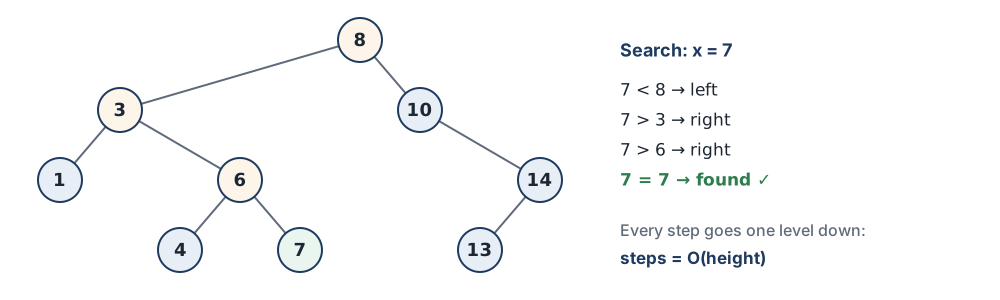
Example: after inserting 8, 3, 10, 1, 6, 14, 4, 7, 13 the inorder is: **1 3 4 6 7 8 10 13 14**
It is not enough that every node is larger/smaller than its **direct** children – the condition applies to the **whole** subtrees!
---
## Search
---
## Search – algorithm
Iteratively
```text
Function Search(Root, x)
P ← Root
While P ≠ Nil and Elem[P].Key ≠ x
If x < Elem[P].Key then
P ← Elem[P].Left
else
P ← Elem[P].Right
End if
End while
Return P // Nil if not found
End function
```
**Minimum:** always left, as long as possible
**Maximum:** always right, as long as possible
Java
```java
boolean contains(int x) {
Node p = root;
while (p != null && p.key != x)
p = (x < p.key) ? p.left : p.right;
return p != null;
}
```
Go
```go
func (t *BST) Contains(x int) bool {
p := t.Root
for p != nil && p.Key != x {
if x < p.Key {
p = p.Left
} else {
p = p.Right
}
}
return p != nil
}
```
---
## Insertion
---
## Insertion – algorithm
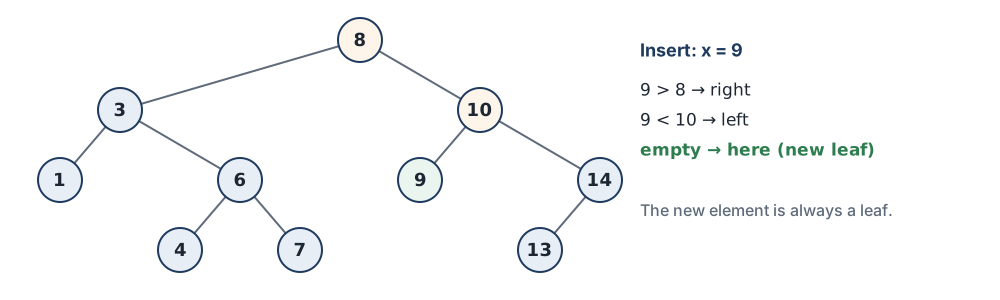
```text
Function Insert(P, x) // returns the new subtree
If P = Nil then
Reserve(Q) ; Elem[Q].Key ← x
Elem[Q].Left ← Nil ; Elem[Q].Right ← Nil
Return Q
If x < Elem[P].Key then
Elem[P].Left ← Insert(Elem[P].Left, x)
else if x > Elem[P].Key then
Elem[P].Right ← Insert(Elem[P].Right, x)
Return P
End function
```
```java
Node insert(Node p, int x) {
if (p == null) return new Node(x);
if (x < p.key)
p.left = insert(p.left, x);
else if (x > p.key)
p.right = insert(p.right, x);
return p;
}
```
Call: `root = insert(root, x);`
---
## Deletion – three cases
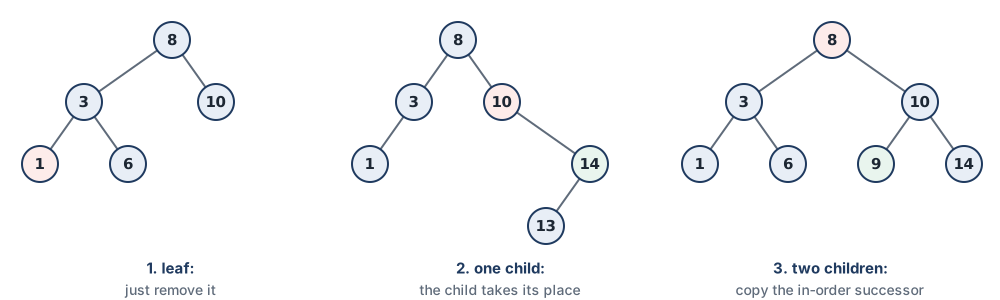
- **Leaf:** simply deleted
- **One child:** the child (with its whole subtree) takes the place of the deleted node
- **Two children:** the **smallest** element of the right subtree (the **inorder successor**) is copied into its place, then that one is deleted – it has at most one child
---
## Deletion – code
Java
```java
Node delete(Node p, int x) {
if (p == null) return null;
if (x < p.key) p.left = delete(p.left, x);
else if (x > p.key) p.right = delete(p.right, x);
else {
if (p.left == null) return p.right; // 0 or 1 child
if (p.right == null) return p.left;
Node s = p.right; // 2 children:
while (s.left != null) s = s.left; // inorder successor
p.key = s.key;
p.right = delete(p.right, s.key);
}
return p;
}
```
Go – the case of two children
```go
default:
if p.Left == nil {
return p.Right
}
if p.Right == nil {
return p.Left
}
s := p.Right // inorder successor
for s.Left != nil {
s = s.Left
}
p.Key = s.Key
p.Right = del(p.Right, s.Key)
```
The full code: `w15/bst`
---
# Balance
---
## The efficiency of a search tree depends on its height
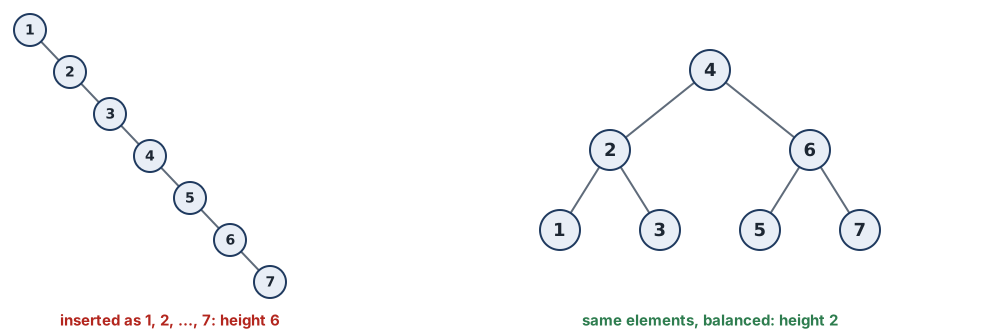
- Search, insertion, deletion: **O(h)**, where *h* is the height of the tree
- **Balanced** tree: h ≈ log₂ n → **O(log n)** · **degenerate** tree: h = n − 1 → **O(n)** (a list!)
- **Measurement:** 1000 elements in sorted order → height **999** · in random order → height **18**
---
## Balanced search trees
**Balanced tree:** in every node the heights of the left and the right subtree differ **by at most 1** (AVL condition).
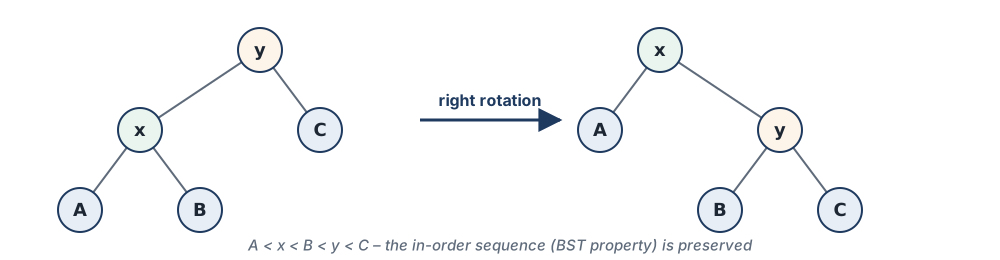
- After insertion and deletion the tree is restored with **rotations** – one rotation is O(1)
- **AVL tree** (1962), **red-black tree** (Java `TreeMap`, `TreeSet`), **B-tree** (databases, file systems)
- Guaranteed **O(log n)** search, insertion, deletion
---
## Search tree, sorted array or hash table?
| Operation | Sorted array | Hash table | Balanced search tree |
|---|---|---|---|
| Search | O(log n) | **O(1)** on average | O(log n) |
| Insertion, deletion | O(n) | **O(1)** on average | O(log n) |
| Minimum, maximum | **O(1)** | O(n) | O(log n) |
| Sorted traversal | O(n) | O(n log n) | O(n) |
| Range [a, b] | O(log n + k) | O(n) | O(log n + k) |
If we only need to search: **hash table**. If the **order** matters too (smallest, next, range): **search tree**.
---
# Heap
---
## The heap
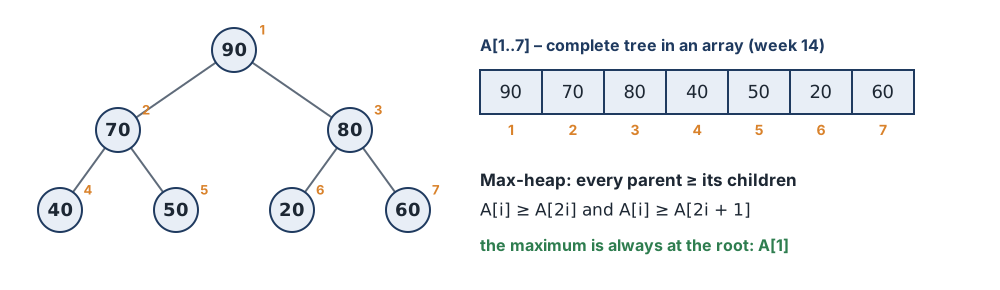
- A **complete** binary tree, stored **in an array** (week 14: children 2i and 2i + 1, parent i div 2)
- **Heap property:** every parent ≥ its children (max-heap) – or ≤ (min-heap)
- There is **no** order between siblings – a heap is **not** a search tree!
---
## Insertion: sift up
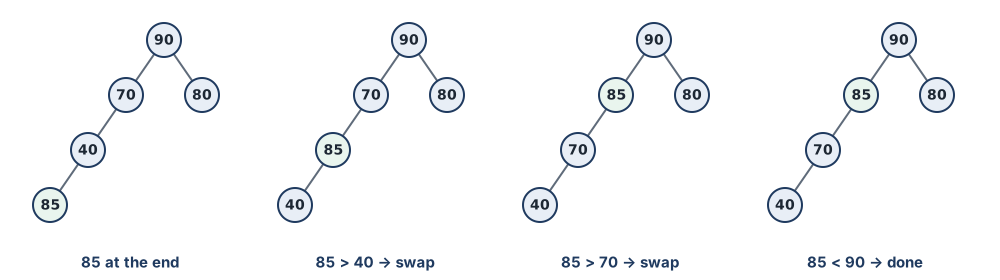
- The new element goes to the **end** of the array (the next free place of the tree)
- While it is larger than its parent, we **swap** them → at most *h* = log₂ n swaps → **O(log n)**
---
## Removing the maximum: sift down
```text
Function RemoveMax(A, n)
max ← A[1]
A[1] ← A[n] ; n ← n − 1
i ← 1
While 2·i ≤ n
c ← 2·i // left child
If c + 1 ≤ n and A[c + 1] > A[c] then
c ← c + 1 // the larger child
If A[i] ≥ A[c] then exit
swap(A[i], A[c]) ; i ← c
End while
Return max
End function
```
1. The **maximum** is in the root – this is returned
2. The **last** element is put into the root
3. While it is smaller than its larger child, we **swap it downwards**
**O(log n)**
| Priority queue | Insert | Remove max |
|---|---|---|
| unsorted array | O(1) | O(n) |
| sorted array | O(n) | O(1) |
| **heap** | **O(log n)** | **O(log n)** |
Java `PriorityQueue` · Go `container/heap`
---
## Heapsort
1. **Building the heap:** build a max-heap from the array in place – O(n)
2. Repeat *n* − 1 times: **swap** the root (the maximum) **with the last element**, consider the heap one smaller, and **sift down** the root
```text
[40, 70, 20, 90, 50, 80, 60, 10] start
[90, 70, 80, 40, 50, 20, 60, 10] heap
[10, 20, 40, 50, 60, 70, 80, 90] sorted
```
| Property | Heapsort |
|---|---|
| Steps | **O(n log n)** – in every case |
| Extra space | **O(1)** – sorts in place |
| Stable | no |
---
# Summary of the course
---
## Data structures – overview
| Data structure | Access | Search | Insertion | Deletion | Week |
|---|---|---|---|---|---|
| array | **O(1)** by index | O(n) / O(log n) sorted | O(n) | O(n) | 3 |
| dynamic array | O(1) | O(n) | O(1)* at the end | O(n) | 3 |
| linked list | O(n) | O(n) | **O(1)** known place | **O(1)** known place | 9–10 |
| stack, queue | only the end(s) | – | O(1) | O(1) | 7, 8, 11 |
| set (boolean vector) | – | O(1) | O(1) | O(1) | 6 |
| hash table | – | **O(1)** avg. | **O(1)** avg. | **O(1)** avg. | 11 |
| search tree (balanced) | – | O(log n) | O(log n) | O(log n) | 15 |
| heap | max: O(1) | O(n) | O(log n) | max: O(log n) | 15 |
* amortized
---
## Algorithms – overview
| Problem | Algorithm | Steps |
|---|---|---|
| search | linear · sentinel · binary | O(n) · O(n) · O(log n) |
| sorting (simple) | bubble · selection · insertion | O(n²) |
| sorting (efficient) | merge · quick · heap | O(n log n) |
| set operations | merging sorted arrays | O(n + m) |
| expressions | postfix evaluation with a stack | O(n) |
| pattern search | naive | O(n · m) |
| tree traversal | pre-, in-, postorder · level order | O(n) |
---
## Preparing for week 16
**Final test** (60 minutes, on paper)
- True/false and multiple-choice questions about the concepts and efficiency
- Code tracing: what does a stack or a queue print?
- Completing pseudocode (missing expressions, relational operators): list, sentinel list and search tree operations
- Algorithms to execute on paper: sorting, binary search, traversal, search tree insertion
**Practical grade** (on the computer)
- Implementing and using a data structure in **Java or Go**
Review the **review questions** and **exercises** of every week – the test is similar to them!
---
## Summary
- **Binary search tree:** left < root < right; the inorder traversal is sorted
- Search, insertion, deletion **O(h)** – three cases for deletion (leaf, one child, two children)
- **Balanced** tree: h = O(log n); sorted insertion → degenerate tree
- AVL, red-black tree: keep the tree balanced with **rotations**
- **Heap:** complete tree in an array, parent ≥ child; insertion and removing the maximum O(log n)
- **Heapsort:** O(n log n), in place
**Next week:** final test and practical grade. Good luck!
---
## Review questions
1. Insert into an empty search tree: 50, 30, 70, 20, 40, 60, 80, 35! Draw it and give the inorder traversal!
2. Delete 30 from the tree of question 1! What does the tree look like?
3. True or false: a binary search tree is always a balanced binary tree.
4. True or false: searching in a binary search tree can be as slow as in a linked list.
5. Insert into an empty max-heap: 15, 40, 30, 50, 10! Give the array after every step!
6. Why is a heap not suitable for quickly finding an arbitrary element?
---
# Practice
---
## Demo programs
| Program | Java | Go | What does it show? |
|---|---|---|---|
| Search tree | `BST.java` | `w15/bst` | search, insertion, the three cases of deletion, degenerate tree |
| Heap | `MaxHeap.java` | `w15/maxheap` | sift up, sift down, built-in priority queue |
| Heapsort | `HeapSort.java` | `w15/heapsort` | building the heap, sorting, timing |
---
## Exercises
1. **Is it a search tree?** Decide whether a binary tree is a search tree! (Careful: checking the direct children is not enough!)
2. **k-th smallest:** find the *k*-th smallest key of a search tree!
3. **Range:** print the keys between a and b so that you enter only the necessary subtrees!
4. **Common ancestor:** find the lowest common ancestor of two keys in the search tree in O(h) steps!
5. **Floor:** find the largest key that is ≤ *x*!
6. **Top k:** find the *k* largest elements of an array with a min-heap of size *k*! What is the number of steps?
Solutions: `Exercises15.java`, `w15/exercises`
In the second half of the practice: **practice exercises for the final test** (based on the review questions of the weeks).
---
## Homework (preparation)
1. Extend the `BST` class with a `successor(x)` method that returns the smallest key larger than *x*!
2. Implement a **phone book** with a search tree (name → number) that can also print the entries in alphabetical order!
3. Implement the **min-heap**, and use it for a simple **task scheduler** (the task with the earliest deadline comes first)!
4. Review the review questions of all weeks, and solve the sample tasks of the old test on paper!